Artificial intelligence in manufacturing
This post discusses Industry 4.0, the directions it may take, and the way AI makes this kind of progress possible.
Here we look at a sector that stands to gain a lot from AI: the manufacturing industry.
At the same time, manufacturers are already reaping the benefits of automation, robotics, and data-driven practices. Industry 4.0 is a dedicated term for bringing technological progress into manufacturing work. We’ll give a short overview of it shortly, and then go through a range of examples showing how AI can help improve this sector.
What is Industry 4.0?
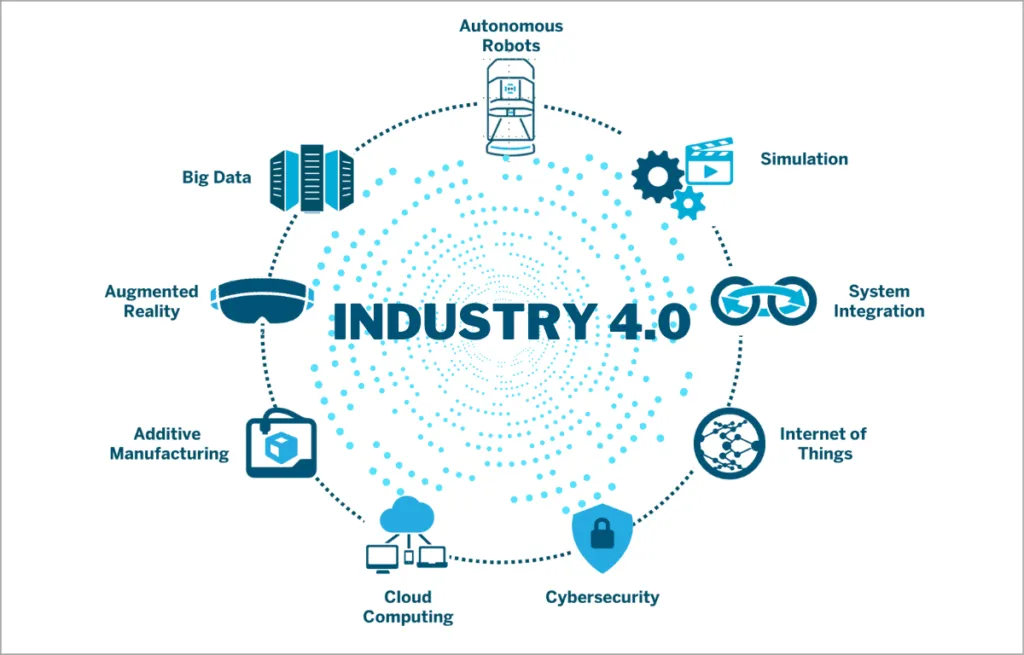
Source: calsoft.com
Industry 4.0, also known as the 4th industrial revolution, emerged as a term in the 2010s and is usually described through four kinds of technologies:
- Greater connectivity: through IoT and cloud technology, sometimes with blockchain in the mix.
- Advanced analytics and data-driven decision making through sophisticated data analysis and machine learning
- Human-machine interaction: VR, AR, robotics, and automation.
- Advanced engineering: 3D printing, renewable energy, or nanodroids.
This may sound very futuristic, yet plenty of it is already in widespread use (for instance, the robotization of warehouses or checkout-free stores such as Amazon GO). Below, I’ll go through several examples, concentrating mostly on the AI side, since that’s what matters most for this post.
AI for the manufacturing industry
Over the next sections, we’ll walk through a handful of major application areas in which AI is making work in factories and warehouses better. We’ll begin with automated quality inspection, then move on to document understanding and automated counting, warehouse safety, and predictive maintenance.
Automatic Quality control in components and finished goods
These examples may not be the most eye-catching, but in large-scale production running in high-performance settings, defective parts have to be spotted and then repaired or thrown away. This matters because such work used to be done by people and took far longer, whereas AI can now significantly boost manufacturing output while cutting production and operating costs.
Challenges of the field
The key challenges in this area are:
- Specialised datasets can be hard to obtain.
- Limited transfer learning potential, since each problem is unique.
- The rareness and diversity of defects may call for Generative solutions (e.g., GANs or Stable Diffusion)
Defects in steel sheets
Sample steel defects from the Severstal dataset.
Let’s begin with spotting defects in steel sheets (although the problem looks similar for other raw materials). It’s a crucial issue, because defective steel sheets may end up in another product and affect its durability or physical properties. Defects range from various kinds of porosity to oxidations and hotspots caused by heat.
The problem gained traction in Deep Learning once the challenge was published on Kaggle, which then gave rise to related papers in the area (e.g., a paper from IEEE). The architectures that worked best for this problem were ensembles of UNets and FPN networks trained specifically on steel defect datasets.
Defects in complex structures (including 3D printing)
Hotspots detected in complex steel structures, source: Towards real-time in-situ monitoring of hot-spot defects in L-PBF
Complex structures, frequently manufactured with 3D printers, are another fascinating area for defect detection. Here, defects may not face the camera directly or even sit on the surface; they may be located on welds or in corners, which makes them hard to catch with ordinary RGB cameras. To get around this, IR/hyperspectral cameras are often used, since they can be less sensitive to environmental interference such as light reflections.
Predictive maintenance
Detecting corrosion, Source: v7labs.com
Since IoT infrastructure is already all around us, we can use some of these sensors to anticipate when particular parts will need repairs (to reduce losses or breakdowns) or just to keep an eye on their condition. In more detail:
- Vibration monitoring – spotting unusual vibrations that may signal the need for maintenance before it’s too late.
- Temperature tracking – thermometers or infrared cameras make it possible to detect overheating.
- Oil quality inspection – through monitoring air pressure in pneumatic systems.
- Wear detection – as in the example above, machine vision is used to find defects.
Background manufacturing process: Documents
Google’s Document AI, source: Google Cloud
Big factories bring more bureaucracy and, sooner or later, an ever-growing number of documents. At some point, one person simply can’t keep track of everything, and that’s where document understanding and OCR come in. I’m not talking about basic OCR, such as reading license plates, but about Relation Extraction (e.g., flexibly working out who sold what to whom and in what quantity), as offered by Google, Microsoft or even Snowflake. Because the subject is fairly complex and comes with many domain-specific challenges, companies seldom opt for specialised in-house tools and instead settle for the “good enough” general-purpose tools from the cloud providers mentioned above.
Challenges of the field
The key challenges in this area are:
- Layout-related problems, such as parsing tables and page breaks.
- Limited access to correctly labeled data.
- Limited handling of multi-language documents.
Automatic counting in mass production
Source:viso.ai
Manufacturing often involves producing large quantities of goods, which may require a fast and dependable way of counting them. This can be achieved with mechanical means or with solutions that just use cameras to determine exact quantities. A Computer Vision app can handle this and can then be deployed in different configurations (mobile apps included). Such solutions typically rely on well-tuned object detection and are fairly easy to build and roll out.
Challenges of the field
The main difficulty in this area, though, is the diversity of environments in terms of background, lighting, and potential occlusions.
Binging safety to manufacturing processes
Incident prediction by Scanflow. Source: scanflow.ai
Warehouses and factories aren’t safe places – injuries or other kinds of damage can happen quite literally around every corner. Any incident can harm both people and equipment, which in turn drives up costs and disrupts the supply chain.
What’s more, warehouses are increasingly filled with automated machines, so sophisticated solutions that anticipate and prevent such incidents are extremely valuable (e.g., near the production line or when pallet racks are being moved).
Scanflow and Surveily are good examples of such solutions. They can not only cut down on incidents but also help enforce particular safety policies in industrial settings.
Challenges of the field
Surveily’s video analysis, source: suveily.com
The key challenges in this area are:
- The temporal aspect of video (e.g., the likelihood of a collision)
- Limited data availability.
- An unlimited range of potential incidents.
New product development
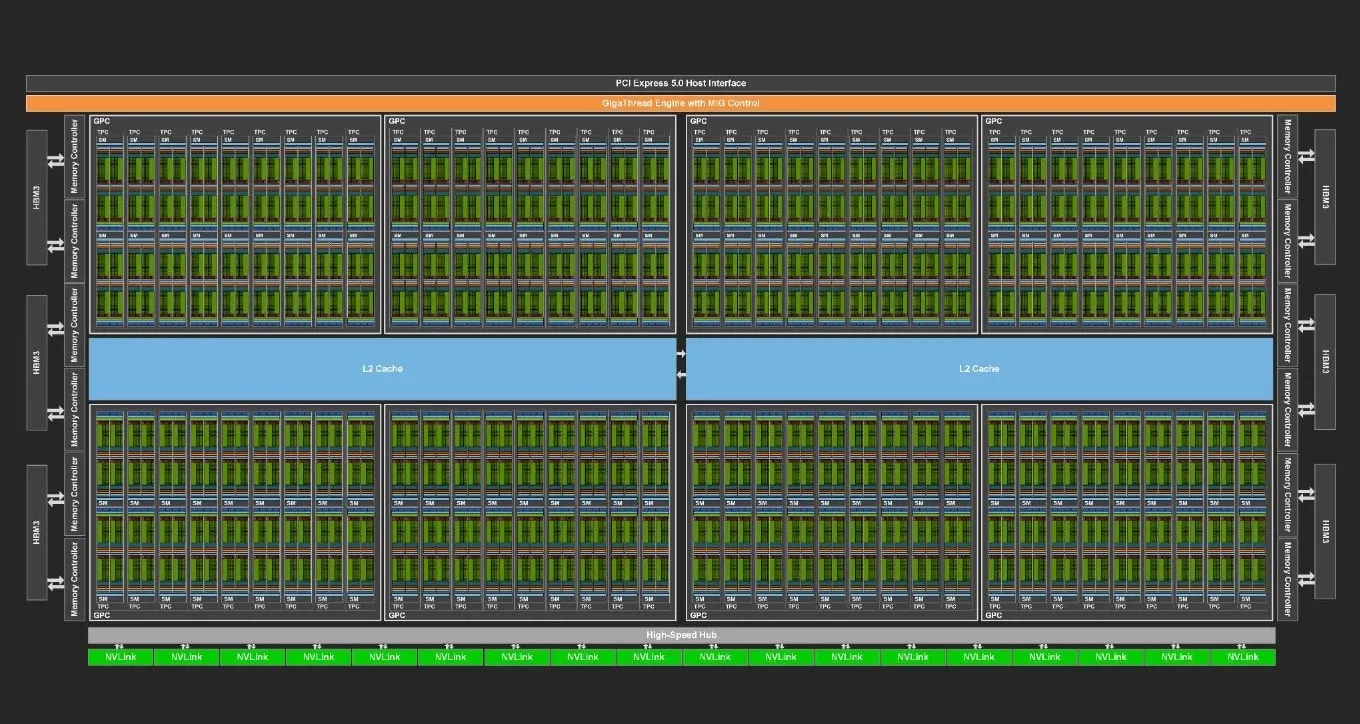
A look at the structure of the Nvidia H100, designed in part by AI, Source: Nvidia
Extensive data on usage, problems, demand, and the market makes it possible to design new and better products.
Nvidia is a great example: it has been experimenting with Generative AI and Reinforcement Learning in chip design.
Challenges of the field
In practice, the key challenges in this area are:
- Evaluation objectives that are not clear.
- Any proposed solution has to respect the laws of physics (which is often tricky with Generative AI).
- The need for an elaborate, detailed simulation environment.
Conclusions
This post discussed Industry 4.0, the directions it may take, and the way AI makes this kind of progress possible. AI is being adopted ever more widely, not just in the form of chatbots but also thanks to progress in applied Computer Vision (as the many examples above have shown).