Big Picture Event Storming: Easy Workshops That Pay Off Big for Your Business
Continuing our effort to spread knowledge about Domain Driven Design and the tools around it, I'd like to present one of the engaging workshops we run in our clients' projects – the Big Picture Event Storming.
Continuing our effort to spread knowledge about Domain Driven Design and the tools around it, I’d like to present one of the engaging workshops we run in our clients’ projects. It’s known as the Big Picture Event Storming workshop, and it helps uncover the business events that matter along the timeline.
Because this workshop is closely tied to the business processes surrounding core domains, I’ll focus on its business benefits rather than on the technical details of running it.
You’ll find out which workshop goals you can define and which of your company’s needs they address. I’ll also explain the source of those benefits – for instance, which risks a workshop reduces when you launch or expand your projects or digital products.
Tangible Benefits for Your Business
In a dynamic, ever-changing environment, being able to adapt our business quickly and effectively is essential. In the short run, we must be able to analyze changes and respond to them fast. During the workshop, we uncovered business processes that reflect reality as closely as possible, with a strong likelihood of getting an accurate picture.
In the long run, though, what matters to us is innovation, cost, and risk optimization. Event Storming can help you on each of these fronts, giving your company a competitive advantage. Consider that many companies may not realise their business processes include inefficient or redundant steps that drive up operating costs.
Running the workshop helps speed up value delivery. Planning and carrying out a project goes more smoothly when the key requirements and business processes are clear and understood right from the outset.
Customers and other users can also be more satisfied thanks to optimal paths through the project, such as shopping paths in online stores. Indirectly, this boosts their engagement and loyalty.
The internal benefits deserve a mention too – better cooperation between teams. With a shared language and greater mutual understanding, teams from various company departments communicate more effectively. Seeing business processes from beyond their local “bubble” helps employees understand one another better. It also encourages people to come together despite their differences, which makes for a friendlier workplace.
Workshops also help bring people together.
This isn’t limited to IT projects. The Big Picture Event Storming can also analyze and uncover more “physical” processes – for instance, organising work across different roles, planning events, marketing campaigns, conferences and presentations, whether recurring or one-time.
The workshop’s output – or, to be precise, the business events along the timeline – can act as potential metrics that help you track progress and company performance in different areas. Picture yourself as the owner of an online store. A dashboard shows you the number of orders per day, and you can follow how many invoices the accounting department has processed, etc. Each of these figures is the total of business-relevant events of a single type within a given time interval. Whenever you change something in your business, you can compare the metric’s current value with its value from before the change. This lets you gauge whether the change, such as a new marketing campaign, worked as intended.
Knowing who (such as an actor, user or employee) triggers an event lets you define the responsibilities of roles and users within the analyzed project.
A single workshop, many goals to reach
In practice, the artifacts produced by the workshop also hold information that is useful across different areas of knowledge, so along the way we can achieve more goals than we initially planned.
Running a workshop is, of course, not a goal in itself. What matters is choosing one main goal that is most important to us, which depends chiefly on our needs.
Below you’ll find the 8 most common Event Storming objectives, each geared towards a different business need.
- Uncovering and understanding the current state, known as “AS-IS” – the focus is on understanding existing business processes, whether or not they are part of the system, without changing anything. This applies especially to areas that are unclear, troublesome and expensive. It helps pinpoint “bottlenecks” and potential areas to optimise. It gives a picture of how the system looks – even when particular steps are tangled and complicated. It’s also useful for new company employees and for engineers who will maintain or develop the project, considerably shortening onboarding time for newcomers.
- Quick and consistent modeling of future processes, known as “TO-BE” – this may cover part of a system or an entire system. The emphasis is on changes, or a new shape of business processes that is consistent, clear, optimal and often innovative. It’s a picture of the processes we ultimately want in the system – in line with the shared view of many different stakeholders. It greatly lowers the risk of misunderstandings, the so-called “deaf phone” between business people and engineers. It gives engineers a solid basis to estimate the work accurately and lets the business side verify it once the project is done.
- Startup/New Project validation – a variant of the “TO-BE” point above, but for projects that don’t exist yet. For ideas about potential products, business models and startups, we can attempt to model their processes in order to validate them. By validation, I mainly mean checking whether it makes sense to build a profitable business that addresses your customers’ needs. We’ll pinpoint the places that will boost your revenue while also bringing value to potential customers. We’ll also check whether implementing it is feasible at all. Uncovering and clarifying vague or unknown parts of business processes helps with this. Ultimately, we can narrow down the MVP scope. Optionally, the resulting artifacts can serve as a basis for rough estimates of how long the project will take to implement.
- Building a shared point of view – helps establish a common understanding and vocabulary within business and project teams, which is essential for effective communication and collaboration. We get there with a simple card-based notation, kept in 1 place and seen identically by all workshop participants. This prevents a situation where every participant keeps their own notes on paper, which could become different and inconsistent pictures of what was learned during the workshop.
- Spotting potential improvements – Analysing the current state of processes and systems reveals places that can be simplified, streamlined or even dropped if redundant. This can save costs and raise productivity. For instance, we can find spots where AI algorithms could automate manual work currently done by people.
- Enhancing User Experience – both for the system’s customers and for company employees such as the support department. When we analyze business processes from the perspective of the people using the system, we can find places to shorten, so that the steps ultimately take less time and satisfaction goes up. This information can also help boost customer engagement by concentrating on opportunities rather than threats.
- Bringing in innovation – Event Storming can spark creative thinking and help come up with new ideas for products/services the market needs. It helps you identify your USP (Unique Selling Proposition). It’s an excellent way to design business processes that nobody has brought to market yet. Often this new area can’t be learned from books or from materials with ready-made recipes, since they may not exist yet.
- Systems integrations – Particularly in large ecosystems, analysing business processes helps us see more clearly how to integrate them, filter out information that isn’t needed and spot potential problems and inaccuracies. After the workshop, project teams tune their APIs for smoother integration.
Taking it apart. What needs doing, and why?
Before I explain where the benefits mentioned above come from, here’s a short story. It will help us narrow things down to the scenarios in which the workshops typically take place.
Picture yourself launching a new venture in line with your business strategy – a technology project, a new department in your company, or perhaps organising an event or a conference.
You’ve already hired people and begun organising work around the project. Getting from the conception of an ambitious business idea to its execution requires diving deep into the initiative. Where should you begin? What comes first? The answers depend largely on the picture of the business processes you want your project to have. You need to know, step by step, what will happen as your product is used.
Taking it further, suppose this particular project is a web application with a minimal feature set that carries out the steps of the intended business processes. You typically have in mind the relevant events that happen within them. For example:
- Invoice was created
- Item added to shopping cart
- Order paid
These events are the fundamental building blocks of the processes we want to explore.
To sum up, we need to uncover what business events we need and why they’re needed. This defines the business value a given part of the project will bring to stakeholders – both owners and customers. That’s why the Big Picture Event Storming helps uncover the relevant business events along the timeline. Eventually, groups of these events will form a key part of the processes in your project.
When the fundamental questions come up
As the workshop phases unfold, we’ll answer the most fundamental questions, such as:
- Who is going to use this particular feature?
- Who is going to have access to it?
- When does the action take place?
- What order do the events happen in?
This tends to be fairly easy, since that information can be read straight from the workshop’s sticky-note notation. For example, cards representing particular Actors will sit next to the relevant business event cards. By Actor, I mean a user able to trigger an action. The Event Storming board shows this information explicitly.
Building the product without information about business processes would be hard. This area, “invisible” at first sight, is crucial to the project from the very start right through to the end of the work, later maintenance included.
Let’s say we skip discovering and modeling business processes. In practice, responsibility for how they look – and thus for the project’s success – then often lands on engineers, who may be, for example, part of a technical team in an IT project. Yet the shape of processes reflects a set of decisions made by the business, so it isn’t something engineers should decide.
New challenges call for modeling before diving into technical details.
Usually, there’s no avoiding modeling. If we skip it at the start, we’ll end up doing it later anyway, while building the project. In practice, the later it happens, the higher the risk of failure, particularly in terms of the cost of changing our project. What kind of failures are we talking about? For example, you’ll end up with features that don’t match reality or your customers’ needs. They may include unnecessary steps, collect irrelevant data or even prevent users from reaching their goals. As you can imagine, modeling touches on areas that matter from the point of view of your customers, users, partners, strategy and vision.
Leaving it to engineers to decide what entire processes look like is a bad idea. You and your company’s employees know best how they look, or should look, from the inside – the people who know their area of work well and who may be affected by the project. As holders of such knowledge, they’re referred to as “domain experts.” They nearly always come from inside the company; exceptions include tax consultants, accountants, lawyers and the like.
Bear in mind, too, that domain experts sometimes lack sufficient knowledge of these processes. Some details may already be forgotten, live only in the heads of former employees, or be poorly defined. And that’s completely fine. There’s no shame in it – in fact, knowing that we don’t know something is essential.
Being aware of both dimensions – the process areas we know and those we don’t – reduces the risk of failure in project development. That knowledge often underpins important current and future decisions about the project. We know what can be achieved and what probably can’t. This can make development cost-effective, as there are fewer misunderstandings throughout the collaboration.
You’re likely wondering now: if the knowledge sits in our heads, how do we get it out? Ideally, it should form a coherent message, be visualised simply and clearly without misunderstandings, and be communicated with confidence to the engineers so that they know exactly what to do and in which order. The “how” is up to them – they’re the specialists.
Close the gap between your strategy and project development
The Big Picture Event Storming workshop is exactly what will help you here. It bridges your business strategy and the building of your digital project.
The method is simple and cost-effective, yet it gives clear insight into operational processes. You find out what is being done, why, in which order, and who can use which features.
Let’s go through a selected set of Event Storming workshop features that matter from a business point of view:
- The simplicity comes from working with sticky notes, gradually expanding the range of card colours. No participant gets swamped with too much information at the outset. Thanks to the low entry barrier, the workshop’s principles are quick to grasp. Nobody will feel uncomfortable, and without mental strain, people will get past the fear of trying the technique.
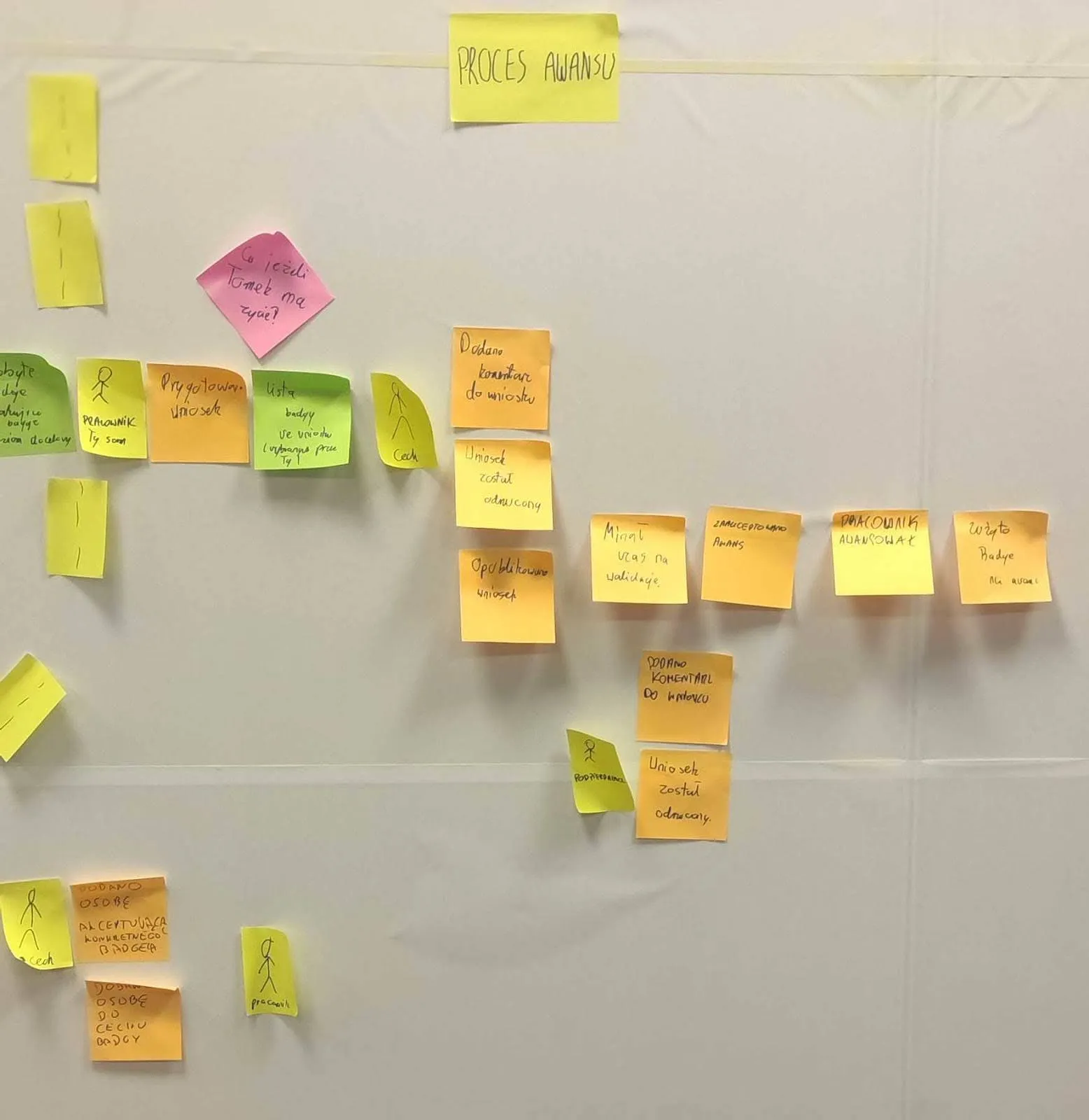
The sticky note notation is what makes it simple.
- Low-cost adjustments – this means being able to quickly and easily change our understanding and model of the business processes under exploration. Think how long changing a process would take if the project – be it a house or an IT product – were already built. Depending on how many factors the change touches, you might even wait weeks. It’s like having a team of engineers knock down a wall in a finished house and build a new one somewhere else. Changing a model during an Event Storming session just means moving stickies around, deleting or renaming existing ones and crumpling up those you no longer need. How long does that take? A few seconds rather than a few weeks of work.
Events discarded during process changes. Moving the cards took seconds.
- The workshop is fast, typically lasting 2 to 3 days at 4 hours a day. That’s a significant advantage over other kinds of product analysis, such as corporate “waterfall”, which can drag on for many weeks or even months.
Note that the so-called “Big Picture” workshop deals with the overall picture of the processes, focusing on discovering them as a whole. Most of the information needed for decision-making is already extracted at this stage.
What isn’t Event Storming?
Stakeholders may have very different backgrounds, along with differing expectations and perceptions of the workshop. While it’s an excellent tool for visualising and understanding business processes, it can also be overinterpreted or misunderstood.
That’s why it’s worth spelling out what Event Storming is not:
- Ready-made project documentation – it doesn’t replace detailed technical documentation such as architecture sketches, infrastructure or UML code. The focus is not on the technical “how” but on the business “what”.
- Project management and its task list – this lies outside the workshop’s scope. Naturally, the artifacts from the workshop can be used to map out initial User Stories in terms of usage scenarios and acceptance criteria, but this mapping takes extra work.
- A user interface (UI) design tool – even though it may contain elements of a data model, such as so-called “views.”
- A technical data model – it doesn’t describe schemas, database types or how they’re implemented.
- Limited to large organizations only – the size and complexity of your project don’t matter. It works just as well for small teams and startups.
- Not a substitute for direct communication – requirements and business environments that change over time still call for adjustments, adaptation and dialogue. On the bright side, the workshop can be run again and again to speed up adaptation.
I’d like to give it a go! What now?
At our company, we have experience running Event Storming workshops for institutional clients and startups, both remotely and on site.
A remote workshop session using the Miro app, among other tools.
Ask yourself: what’s your goal? The list of goals from the earlier paragraphs will help. Pick the one that will bring you the greatest benefit.
Once you’ve answered that question, contact us! We’ll organise and run a workshop for you, guiding you and the other participants step by step and stress-free through the world of Event Storming.