Behind every great software solution is a great team
Organisations need high-performing teams to rise to market challenges, and good partnerships put teamwork and collaboration first to reach success together.
Great software solutions and great teams are clearly connected. In today’s fiercely competitive market, where customer experience comes first, building outstanding products calls for a skilful approach. Building the right product successfully takes more than just responding to market needs – it depends on a strong product organisation that can deliver excellent results.
A successful product organisation relies on a handful of key factors, among them:
- putting the right people in the right roles
- placing emphasis on collaboration
- leaving space for innovation
- taking a problem-solving approach
How well these factors fit together depends heavily on the team’s performance. A high-performing team can lift every one of them, and that is how outstanding software solutions come about.
If you’re searching for a dependable partner to build great software solutions, this article will show you what signals point to high-performing teams. I’ll also describe a real collaboration between our client and one of our software teams, which shows how a great team can make things better.
Case study
How our high-performance team brought the client more value
A year ago, one of our teams started working with an innovative client whose product was developing fast. Its user base was growing quickly, which meant the product had to be scaled continuously, new solutions had to be integrated, and constantly shifting user expectations had to be met. . This kind of work demands a dynamic approach, as we aim to keep up with changing needs and make sure growth goes smoothly. The product roadmaps put optimisation and automation first, and, looking ahead, the ambitious aim of reaching more users.
Over that year, our working relationship with the client changed considerably – from being handed individual tasks to owning features end to end. This shift stems directly from our strong teamwork and engagement. Our team concentrated on building open communication with the client, gathering requirements efficiently and drawing up precise action plans. Thanks to this proactive approach, the client has seen that we are fully able to help them build successful software solutions. Let’s look at this more closely.
It all begins with trust and open communication
In the first phase, the transformation meant setting up transparent, open communication with the client. During the first month of cooperation, our team chose to take the initiative and organise a retrospective meeting. Thanks to this proactive step, they set up regular channels for keeping the client up to date on progress every day. These regular review meetings became a basic rule of the project and helped the team build a culture in which everyone shares ideas and feedback openly.
Results driven by value
A partnership founded on open communication gave our team an environment in which they could make the most of their expertise and turn it into client satisfaction. Because we were open and committed, the client was happy to share their concerns and needs. This allowed the team to handle the client’s requests quickly, leaving nothing unclear.
One example of how we pleasantly surprised the client came when they said they needed innovation in Kafka-connected products. Our team reacted fast and set up an internal meeting with a Kafka expert from our company. Both the quality of the solution and the speed of the response impressed the client and supported the product’s development. This strong commitment and accountability led the client to hand our team even more parts of the project.
These days, the client supplies initial designs for the solutions they need, and our team is responsible for defining how features work, identifying dependencies in the system and working out the implementation strategy. This partnership has given our team members room to develop and to use the full range of their skills. To the client, we have become a trusted partner, sharing a sense of accomplishment as we work side by side towards mutual success.
Lessons learned
Our real collaboration example shows how closely a high-performing team is linked to business results. There are many stories of outstanding teams having a remarkable impact on digital products. Science confirms this: better teamwork processes raise the chances of success by a considerable 20 to 25% (a meta-analysis of 130 studies by LePine et al.). It’s worth noting, though, that smooth cooperation doesn’t always happen by itself – it needs intensive care and deliberate development. Research shows that although as many as 92% of people see teamwork as critically important, a mere 23% believe their teams are genuinely effective.
What, then, makes teamwork so effective?
Let’s use science to unpack the phenomenon of high-performing teamwork.
I’ll concentrate on three models and studies I have used while supporting the growth of IT teams.
- Five Team Dysfunction (Lencioni’s model) – a model created by Patrick Lencioni. It describes how team interactions work and points to five core skills teams need to develop in order to be effective. Lencioni also designed a questionnaire that helps teams evaluate themselves and steers them along their development path.
Inspired by the book The Five Dysfunctions of a Team
- The Seven Drivers of Teamwork Model (7C’s model) – a joint work by Dr. Scott Tannenbaum and Dr. Eduardo Salas, who set out seven research-based drivers of teamwork in Teams That Work and built a practical ‘Teamwork Advisor’ to help teams that want to improve.
Inspired by a webinar on the science of teamwork
- Five Key Elements of Successful Teamwork (Google’s model) – this model came out of Google’s extensive research launched in 2012. Over more than two years, they evaluated 180 teams and held over 200 interviews with employees. After analysing 250 team attributes, they singled out five key elements that strongly affect teamwork. What they found was that, more than who is on a team, what matters most is how team members interact.
Based on this article
With the help of these three models, I’ll reveal the key elements that make our teams perform so well in supporting customers.
Before we walk through the key elements of teamwork, let’s look at how our team rated its teamwork skills using Patrick Lencioni’s assessment.
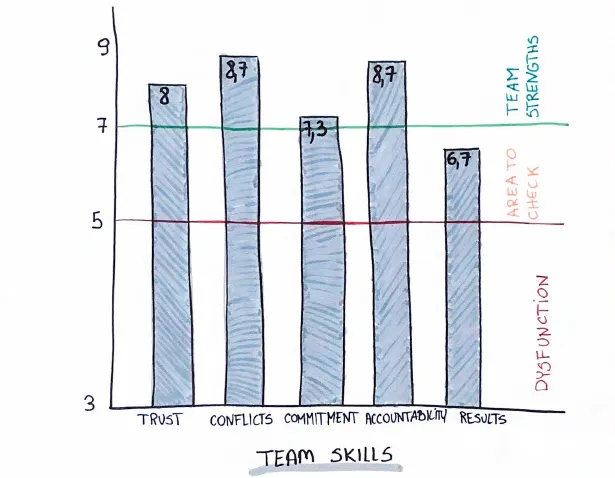
Team self-assessment based on a study of team dysfunctions developed by Lencioni
Where our team stands on Partick Lencioni’s scale
The assessment revealed that our teamwork drivers are strong. The results point to the team’s strengths and confirm how valuable the one-to-one feedback sessions run by team members are. This motivates the team to keep nurturing a culture of open communication and collaboration, both inside the team and with our clients.
The Key Elements of Teamwork in Our Team
Let’s see how these elements of teamwork play out in our team.
1. Trust and psychological safety
Lencioni’s model treats trust as the cornerstone of effective teamwork.When trust is high, team members can show vulnerability without fearing judgement. People in such teams are more willing to voice their opinions, and they try to understand others’ motives instead of jumping to conclusions.
This echoes Google’s research, which points to psychological safety as the single most important team attribute. Teams with high psychological safety are twice as likely to be judged effective by managers (source).
The 7C’s model likewise names trust as a significant element of effective teamwork. In defining collaboration, the authors state that team members who don’t trust one another can’t work together effectively.
Our team enjoys a very high level of trust. Team members keep it up through one-on-one conversations that clear up any misunderstandings. They aren’t afraid to speak their minds and share their thoughts.
To keep things psychologically safe, team members are free to ask for help or admit that they don’t know something.
2. Conflict management and communication
Lencioni’s model lists openness to conflict as another key skill of high-performing teams. Members of such teams don’t shy away from putting forward ideas that differ from those of others. When a conflict concerns the issue rather than the person, it lets the team consider more perspectives and make better decisions. Ineffective teams either steer clear of disagreement or let it escalate into quarrels, which stops them from reaching the best solutions.
The 7C’s model stresses the way good teams share information. High-performing teams care about the quality of information, not only how much of it there is. They achieve this by sharing valuable information and understanding one another instead of guessing. This keeps communication clear and complete, and it resembles the constructive conflict described in Lencioni’s model.
The assessment shows our team handles conflict well. Its members share their views and make an effort to understand one another. Differing viewpoints don’t frighten them; they see them as a chance to look at things from a fresh angle, without fear.
3. Commitment and cognition
Next, Lencioni’s model points to commitment as a skill of high-performing teams. In a committed team, meetings are engaging because everyone takes part. Decisions are made after discussing and working things through together. Everything is clear, since people talk through doubts and differing opinions and therefore understand the choices made.
Commitment in Lencioni’s model corresponds to the cognition aspect of the 7C’s model. Studies have found that teams with a Shared Mental Model perform better. Teams may hold various kinds of Shared Mental Models.
Inspired by a webinar on the science of teamwork
Our team is strongly committed when it comes to making decisions. Everyone takes part in the discussions – even the front-end expert gets a say on back-end matters. They also understand the business well, because they gather requirements carefully and discuss the customer’s needs and ideas with them.
4. Accountability and coaching
Once decisions had been taken, strong teams took ownership of carrying them out. According to Lencioni’s model, great teams hold themselves accountable and do whatever is needed to reach their goals. It resembles a relay race, in which everyone has a role and knows they’re all in it together. They help one another naturally by giving feedback and sharing ideas, which keeps work progressing collaboratively.
The ‘coaching’ driver of the 7C’s model appears to match accountability in Lencioni’s model. The authors say that in effective teams, members can show leadership behaviours like holding teammates accountable, clearing obstacles and supporting learning and adaptation.
Our team’s assessment shows that accountability is among its strongest skills. They proved it by proposing improvements. For instance, while working on the customer’s solution, one of our team members grasped the situation and suggested an improvement that made the process safer. The team knows the product requirements very well, so it can judge which tasks matter most and adjust quickly when needed. They feel just as responsible for the product as the customer does.
5. Focusing on Result and Collaboration
Lastly, Lencioni stresses that a strong focus on results is a defining trait of high-performing teams. Members of such teams are always willing to back and help one another to get the best possible results. This spirit of collaboration pushes them to pool their varied skills and knowledge to deliver effects, raise the quality of their work and grow together.
In the same vein, the 7 C’s teamwork model underlines how important collaboration is. Studies have found that teams with collective efficacy perform better.
A focus on results is a major part of our team’s skill set. They work closely with customers, handling both big-picture strategy and everyday operations. Tema understands that the product is at an early stage and that not every use case is well understood yet. That’s why they concentrate on close collaboration and information sharing with the customer. The team is always open to finding new solutions or improvements.
6. Capability
The 7Cs model stresses that very effective teams have to consist of people with the right knowledge, skills and attitudes to handle project requirements and other challenges well. It’s important to realise that a team’s capability is about more than technical aptitude.
This is why, having completed a range of commercial projects, we treat the evaluation of soft skills as seriously as our engineers’ technical skills.. During recruitment we make sure to choose people who combine technical expertise with the right attitude for working together. Getting as many engineers as we can involved in the selection process lets us gauge compatibility and secure a cohesive, harmonious team dynamic.
7. Conditions
Conditions are crucial in shaping effective teamwork. The 7C’s model stresses that the organisational environment can either encourage or discourage team members’ willingness to cooperate. Promotion decisions, degrees of control, access to resources and a balanced workload can all strongly affect the level of teamwork.
In our Organisation, we are dedicated to building a work environment that encourages teamwork and lets our team members flourish. How does this work in practice?
- We make sure our team members get the tools and support they need to do excellent work in their roles.
- We support social connections as a key part of effective collaboration. We appreciate networking opportunities where we can meet and build relationships that strengthen our cooperation on future projects.
- We empower our experts by letting them choose to take part in projects that fit their interests. This autonomy lets them apply their expertise in line with their passions and fuels their commitment to delivering excellent results.
- When a project is running, our experts are free to build meaningful collaborations with clients. This open, flexible approach promotes effective communication, understanding of client needs and solutions tailored to keep clients satisfied.
In my experience, teams that embrace these key elements build excellent software solutions and tap into the power of teamwork.
Summary
High-performing teams can make a decisive difference, particularly when dealing with challenges such as scaling, pioneering new solutions and keeping product development on course in an ever-changing market. Their expertise and performance can give the support needed to tackle challenges with consistent quality.
Effective teams matter within your organisation as well as when you partner with others. Partnering is not only about technical skills – it’s about judging how well an organisation can cooperate and how it shows its commitment to teamwork. This holistic approach secures not just technical expertise but also an environment in which collaboration flourishes, resulting in shared success.
The right partners and advisors grasp the complex relationship between technical skills and team skills, and they care about building high competence in both.