An Irish adventure: Dublin Tech Summit 2024
Find out what's new from Dublin Tech Summit. One of our engineers has prepared a thorough recap you definitely shouldn't miss.
Last week at Dublin Tech Summit 2024 I had the chance to meet people who share my interests, hear from influential speakers, and pick up some knowledge about AI and tech trends in the business world. In this post I summarize what I learned and point to where AI and tech may be heading in the business community.
About the conference
Dublin Tech Summit ranks among the biggest Tech conferences, featuring prominent speakers such as Jack McCauley (co-founder of Oculus), Jeremy King (CTO of Pinterest), and Dr. Omar Hatamleh (Chief Advisor at NASA). Launched in 2017, it attracts over 8,000 attendees every year, and 150+ startups showcase their groundbreaking products there (us included, as our company’s machine learning team, offering Science as Service).
Interesting presentations
Building a more Human (and Humane) Internet with AI by Jeremy King, CTO of Pinterest
Pinterest’s skin and hairstyle features (source: pinterest)
Pinterest is a platform people visit for inspiration, so it depends on client engagement. To make the system better, they ran a number of small ML projects that boosted engagement:
- beginning with a skin colour detector (along with the option to filter by it),
- going further with hairstyle detection, and ending with body type, probably relying on zero-shot classification given the wide variety of classes.
The talk presented how Pinterest raised user engagement by making the platform more inclusive for its audience. It demonstrated that rather than always following the crowd, you can take small steps and pay attention to what the client needs.
What struck me most was how polished the presentation was: clean in design and easy to follow for a less technical audience, without wrapping everything up in the word AI.
Race against the Machine: How to Ensure Compliance with Fundamental Rights in the EU AI Act by a postdoctoral researcher at Trinity College London
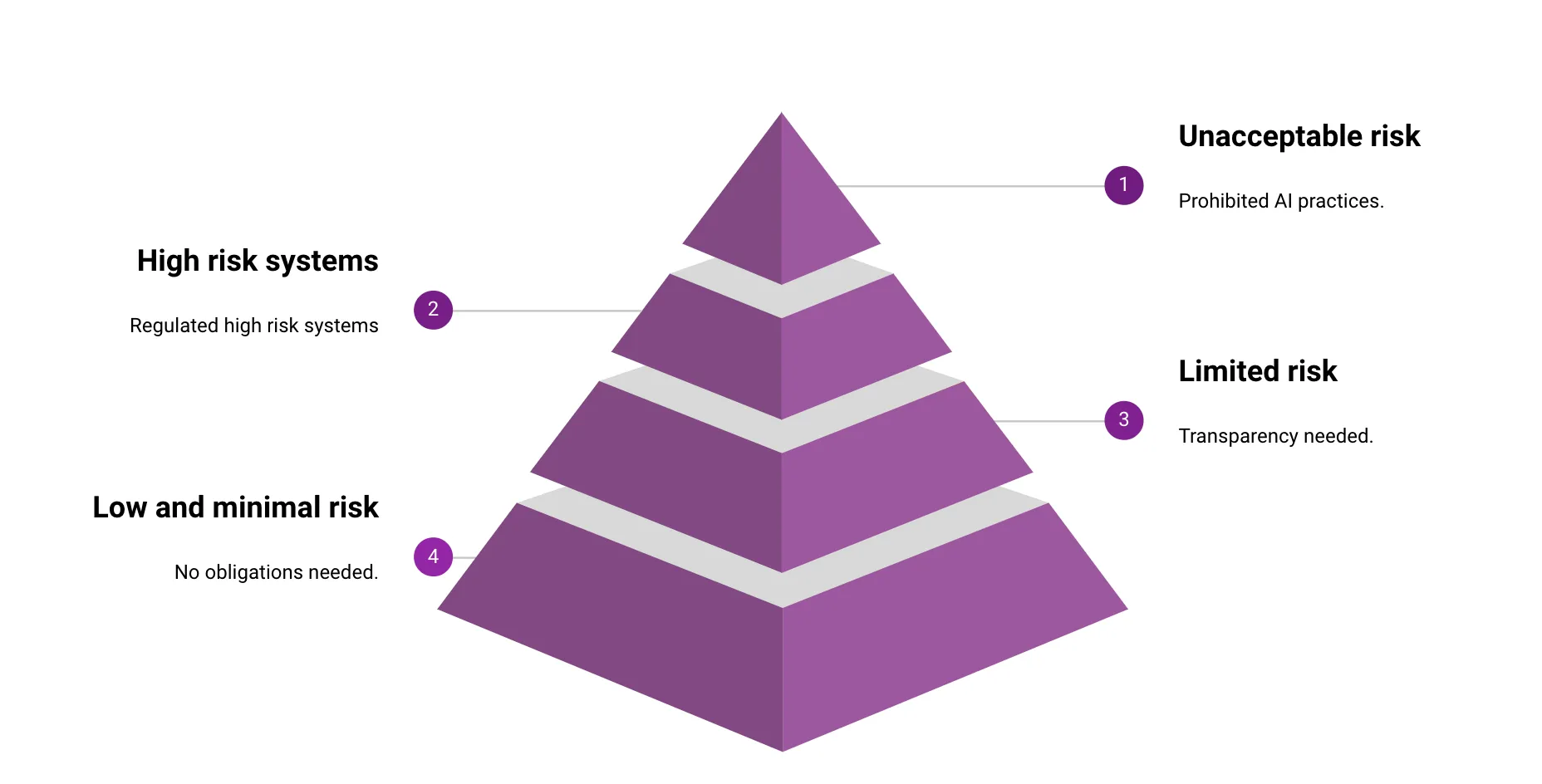
Risk pyramid based on the EU AI Act
The talk covered the hot subject of AI regulation and its various risk levels. It also offered an interesting way of deciding which areas count as high risk, summed up by the motto, “The more something touches fundamental rights, the more tightly it is controlled.”. It turns out that several countries (e.g., the Netherlands or Canada) already have frameworks for evaluating the risks of AI algorithms, giving authorities better guidance on regulating new inventions such as GenAI. Well-designed regulations could also protect particular disadvantaged groups (such as children, senior citizens, or physically disabled people), who are more exposed to the latest technological advances. To learn more about the EU AI Act, visit artificialintelligenceact.eu.
The Power of the Niche: Building Europe’s First Sovereign Legal AI by Prof. Michael Huth, Cofounder of Xayn
This talk was an eye-opener, revealing how hard it is to use RAGs and LLMs in LegalTech. The difficulty stems from a core trait of LLMs: they work with probabilities, so word synonyms are treated as good enough. That may be fine in other domains, but the Law domain is extremely detail-oriented, and poor wording can lead to a lawsuit. A good illustration is the pair of words “possession” and “ownership”. In everyday English they are synonyms. Legally, however, they are defined differently and carry completely different consequences, so a “close enough” approach won’t do. The speakers also discussed the ongoing AI race between countries, led by the USA and China, with France (e.g., Hugging Face, Mistral) and Germany (DeepL or Aleph Alpha) deserving a mention. Financially, Europe is falling behind in this race, largely due to: less capital, more regulation and greater diversity (of languages, cultures and regulations).
Unleashing the Power of Collaborative Intelligence: Harnessing the Power of Multi-Agent Systems by Paul Walsh, AI Innovation Director at Accenture
A multi-agent system example from AutoGen, Microsoft’s framework for LLM agents
This talk matched my recent interest in LLM agents, so I chose to attend. It offered a gentle introduction explaining why agentic workflows outperform simple RAGs (better factuality), along with intriguing findings such as that electing a leader improves quality (related paper), and promising new directions in the field: self-evolution (the agent learns while operating) and dynamic generation (new agents are spawned on the fly).
Conclusions
The conference made it possible to see which themes are currently hottest among startups (through their stands) as well as among larger companies and their talks (e.g., Pinterest or Accenture). The dominant topics across all of them are clearly Retrieval Augmented Generations, Language Agents and multimodal services (producing images, analyzing charts or generating related audio recordings, all within one tool). These are exactly the areas our R&D department concentrates on, so we are happy to be on top of things and at the forefront of the newest developments in AI.