Tech Trends worth following in 2025
Here comes our fifth yearly deep dive into where tech is heading.
Here comes our fifth yearly deep dive into where tech is heading!
This list combines an engineering perspective with 15 years of experience as a software agency.
Security-first and Security-left
Cybersecurity is not only about keeping hackers out, but also about making sure the business keeps running smoothly as technology evolves. We feature it in our trends list every year, because we see how much it matters in our everyday work. For some companies, especially in critical industries such as FinTech and MedTech, tackling security challenges goes beyond one-off certifications or running a Security Operations Center (SOC). It requires ongoing work: security testing, proactive vulnerability audits, and training for all staff, not only technical teams. This steady dedication is what distinguishes security-aware companies from those that do not manage to put solid long-term strategies in place.
In 2024, we put even more emphasis on helping our clients adopt a security-first mindset. The World Economic Forum lists cybersecurity among the biggest global threats, which means the future will be shaped by prevention rather than compliance alone. In 2025, simply ticking compliance boxes or merely responding to vulnerabilities may no longer suffice. A security-first culture will grow from a niche concern into a central organisational strategy.
As a software agency, we stress that the quality of your codebase matters just as much as your infrastructure. Taking a security-first approach means spotting threats in code early. By moving security “left” on the timeline of a software development project, it turns into a fundamental building block instead of something bolted on at the end.
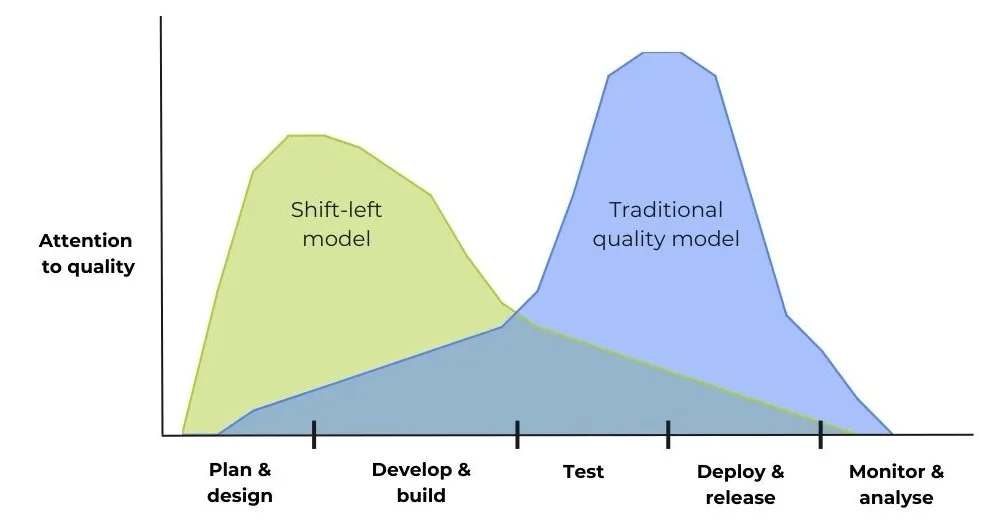
Source: Devopedia
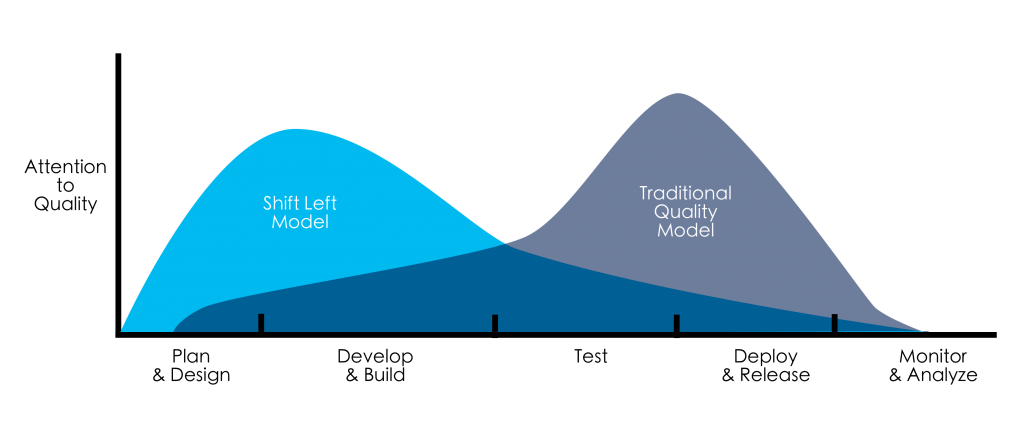
This cuts down vulnerabilities before they turn into critical problems, keeping security debt low. In 2025, it will be an essential part of software development, together with building security into the DevOps pipeline (SecOps), to boost resilience and create products that are secure by design and also able to adjust to new threats.
In our trends for 2024, we forecast that progress in quantum computing would influence where technology goes. This year brought a worrying milestone: Chinese researchers broke traditional RSA encryption using quantum annealing systems, which could threaten cybersecurity worldwide. Back in 2023, Signal rolled out a quantum-resistant protocol, and in 2024 Apple followed suit. Google has also just built Willow, a new cutting-edge quantum chip with 105 qubits and quantum error correction.
We believe that by 2025, organizations need to get ready for the possible effects of quantum computing on cybersecurity. Getting ready means understanding the particular risks that quantum progress brings, so that agility can be built into their cybersecurity frameworks.
AI development and human-AI collaboration
Let us keep in mind that IT systems are being attacked from every direction: cybercriminals chasing profit, hostile nation-state actors, global botnets, and even competitors trying to disrupt operations. In 2025, with cybercriminals armed with AI, this will only increase.
By 2025, AI will boost not just the scale of cyberattacks, but also how precise and sophisticated they are. We can anticipate:
- phishing emails written with perfect grammar and filled with personal details,
- fake phone calls in which a generated voice imitates people we know,
- data breaches caused by employees accidentally sharing sensitive information with AI platforms such as ChatGPT,
- highly adaptive malware able to learn from real-time data and adjust on the fly, making it even harder to detect,
- AI being used to find 0-days in existing software.
CISOs need to protect their sensitive data, explain the risks AI poses within organizations, and proactively put the right strategy in place and steer it. At the same time, AI could be a game changer, giving organizations the tools they need to fight ever more sophisticated cyber threats. This covers:
- detecting and preventing threats,
- automated response to incidents,
- predictive analytics,
- and analysis of behavior.
AI tools will make adaptive learning, round-the-clock 24/7 protection, and greater efficiency and accuracy possible.
A report from the World Economic Forum states that although AI and robotics will replace 85 million jobs by 2025, they are also expected to generate 97 million new positions in fields such as AI development, data science, and human-AI collaboration. In our machine learning team, our ML engineers expect large language models (LLMs) and agentic workflows to keep evolving, along with progress in medical technology, such as avatars gaining ground in healthcare - a perfect example of human-AI collaboration.
As a software agency, we notice AI tools becoming increasingly embedded in everyday work. ChatGPT has launched desktop apps that let users interact with IDEs. Microsoft is working on Copilot and the contentious Recall feature.
New brands are also appearing on the market, such as the Cursor IDE, built from the ground up with AI integration in mind and letting users work with code using natural language. This strongly supports the no-code low-code movement, in which non-technical people can build smaller applications by themselves, without having to learn programming languages.
Still, one can see that the AI hype is cooling off. Large companies talk about AI a great deal, but real use cases have been somewhat disappointing. We do not expect a revolution in this field next year, but rather an evolution that fills out the use cases where AI truly adds value.
FinOps popularity is growing
The past few years have been tough on the market. Inflation and higher interest rates have affected VC investment in startups and pushed companies to think about cuts and savings. At the moment, many companies are concentrating on cloud cost optimization, leaving the cloud, or optimizing company spending in general. The term FinOps has spread more widely, and a variety of related tools are becoming popular. There is even a FinOps foundation operating under the Linux Foundation. We expect this trend to carry on into 2025.
The final months of 2024 gave the market some hope, with interest rates going down. Investment may pick up in the months ahead. Some companies that delayed their IPOs (Initial Public Offerings) while waiting for better conditions are now thinking about going public in 2025 or 2026. They will surely want to present the strongest possible results, including lower costs and higher profitability, by cutting spending on the cloud and in other areas.
Legacy modernization
And what about legacy systems? Pressure to show profits and cut costs pushed companies to concentrate on features and business value. In the meantime, legacy systems became even more outdated. In the long run, modernization cannot be skipped if future development is to be fast and efficient. Most companies intend to raise IT spending in 2025. We think they may decide to revisit their old systems to boost organizational effectiveness, security, and developer experience. Some might even choose to rewrite legacy systems using new technologies. At times, the motivation is to unify the company’s technology stack, which makes hiring easier, lowers operating costs and unifies observability. In other situations, infrastructure costs lead decision-makers to pick more efficient languages, for example Rust.
Not surprisingly, AI has a part to play in software modernization.
- AI-powered tools make dependency and version upgrades easier,
- AI algorithms simplify writing tests, making it easy to add more regression tests that help in modernization and rewrite scenarios,
- As always, though, the privacy of AI-based tools remains an open question. Companies need to decide whether they are comfortable uploading their entire codebase to, for example, an AWS cloud solution dedicated to AI.
Having said that, Java, Python, and TypeScript have cemented their status as the most popular and broadly used programming languages. Because they are so versatile, the platforms around them are frequently picked as the target when technology stacks are being unified. Access to talent matters here, as does the fact that a well-maintained library exists for any common problem.
CRDO at our company
Rust is the most beloved language
Legacy systems are built on old but gold technologies, yet new contenders are emerging for greenfield projects, and not only those. If you have kept up with the IT world lately, you have probably heard a lot about Rust. Unsurprisingly, Rust’s rising popularity has plenty of developers enthusiastic and keen to adopt it. We covered it in our trends for 2023 and 2024.
The Stack Overflow Developers Survey reports that “this year, Rust once again tops the most-admired languages, scoring 83%.” 12.6% of respondents chose Rust when answering the question: “In which programming, scripting, and markup languages have you done extensive development over the past year, and which would you like to work with next year?”.
We appreciate the importance of game-changing technologies such as the Rust programming language, which marks its 10th anniversary in 2025. We think 2025 could see this technology adopted more widely in real-world projects.
Return to the office
When it comes to how global tech companies operate, 2024 was marked by high-profile returns to the office. Companies such as Amazon, Disney, Salesforce, and others started calling employees back to the office, either full-time or in a hybrid model. Why? There are various reasons. Some claim that working in the office is more efficient, while others think it encourages more creativity. Recruiters often explain in LinkedIn posts why they consider in-person work superior. By contrast, companies such as Spotify have said outright that they do not intend to follow suit. They are instead sticking with flexible remote work because, in their words, employees “are not kids.”
So what is really going on? At times, changing remote work policies is a quiet way of nudging people to resign, shrinking teams without official layoffs. In other cases, companies may have signed long office leases just before COVID-19 and now want to make use of those spaces by bringing employees back.
Hybrid work combines the advantages of both styles of working, but it can have downsides too. Some employees, for instance, say hybrid arrangements feel like having a “Monday” twice a week. Others point out that with hybrid policies, team members may come in on different days, so they end up on Zoom calls despite being in the same building.
Mandatory returns to the office are frequently controversial. The pandemic let companies hire talent from many different places, and requiring office attendance might force some employees to relocate. Policies are sometimes different depending on how far from the office an employee lives, which raises questions about fairness and equality.
And what does the research show? Studies give a mixed, though mostly positive, view of remote work.
- McKinsey reported that 87% of employees offered the option of remote work made use of it.
- Harvard Business Review pointed out that making employees return to the office often results in lower satisfaction, more stress, and higher turnover.
- Microsoft’s 2023 Work Trend Index showed that 82% of managers believed their teams did as well or better while working remotely. Remote work also lets employees – developers in particular – concentrate on their tasks without the distractions typical of offices.
Smaller companies have run their own studies, but they frequently cannot prove decisively which style of work, remote, in-office, or hybrid, is better for performance or mental well-being.
Heading into 2025, the debate over remote work and return-to-office policies is likely to heat up. What appears certain is that flexibility is still the best way forward. A Stanford University study found that flexible work arrangements considerably raise employee engagement. That is how we have worked from day 0, 15 years ago.
Wrap up of our tech trends
From proactive cybersecurity and flexible work policies to adopting AI and modernizing legacy systems, 2025 will be shaped by smart investments, business adaptability, and an emphasis on long-term value. We are curious – which trends has your engineering eye picked up? What do you expect to see more of next year? Tell us your predictions in the comments below!
Many thanks to our colleagues for the insightful conversations! Your knowledge and viewpoints helped shape this year’s tech trends edition.