Why Rust Is the Top Pick for Building Software Today
Find out why Rust is the top pick for building software today.
If you’ve been following the IT world at all over the last few years, chances are the word Rust has come up more than once in conversations about programming. You might even have a rough idea of why that is, and why so many people are enthusiastic and hopping on the Rust bandwagon. The usual claims are:
- Rust is a system language (true, though I’m convinced it will spread to areas other than system programming soon – the crates analysis section below backs this up ;) )
- Rust comes with excellent built-in memory safety
- Rust is fast
- Rust is concurrent
There are countless blog posts confirming the points above and praising how fast or safe Rust is. If Rust has ever reached your ears, it was most likely through one of these claims. That’s why I won’t add yet another post about Rust’s great features. I’ll concentrate instead on a few aspects worth weighing when you look at existing tools, technologies, frameworks and, above all, the language itself, before kicking off a new project or deciding to rewrite an existing microservice into a faster and safer Rust version.
Why Rust
Whenever you choose a language for your team, some of the candidates are riding a wave of hype (and Rust is clearly one of them right now). Yet, as an experienced CTO or manager at an IT company, you know hype alone isn’t a sufficient basis for a decision. You need solid facts about the technology: where it’s heading, who uses it, whether it will last, and, crucially, whether you’ll find people keen to work with it.
If that describes you, or you’d like to convince someone like that because you love Rust yourself, I’ve put together a list of less obvious Rust advantages to use when thinking about switching, whether for a project or a team.
I went through several sources of freely available data so you can see where Rust stands, who wants to use it, whether the Rust ecosystem (crates) is mature enough, and what the job market looks like for Rust engineers and people aiming to become one.
TIOBE Index: Rust programming language
The well-known TIOBE Index, which tracks how popular programming languages are (it’s refreshed every month and sheds light on software development trends), shows that Rust’s popularity has risen sharply over the past two years.
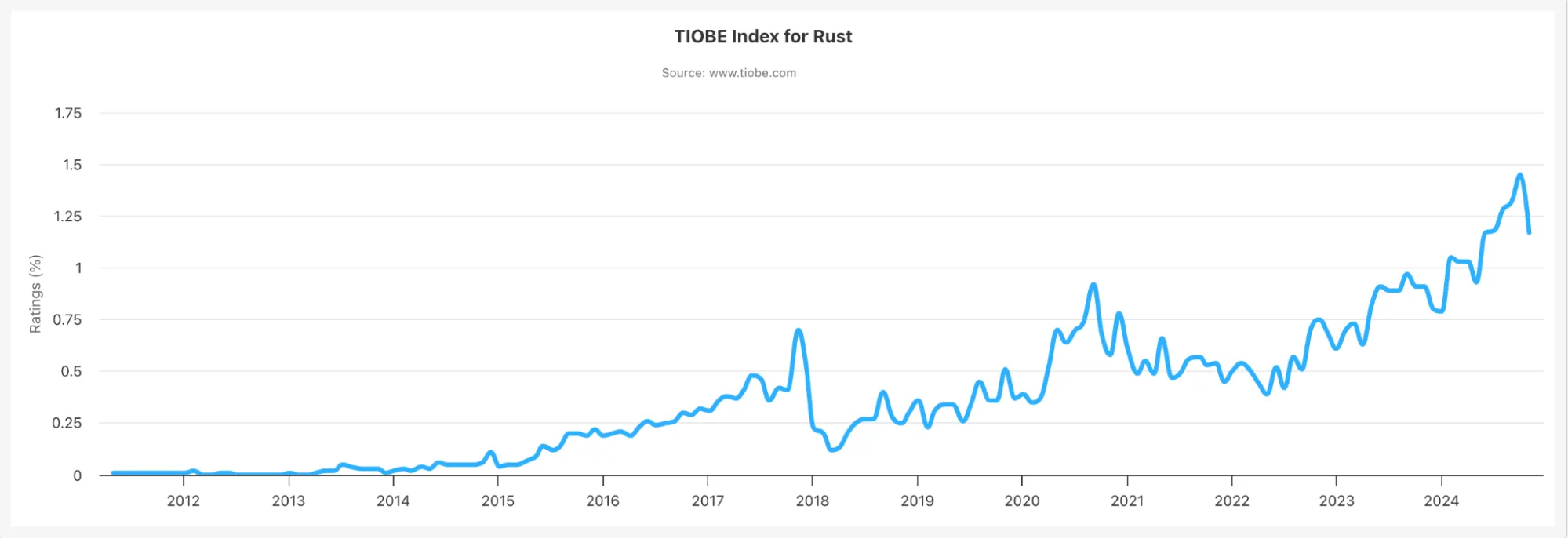
Rust in the Tiobe Index
The TIOBE Index counts search engine results for queries that include a programming language’s name, then aggregates and normalizes them into a ranking. It can help guide the choice of language for new projects, but it has its weaknesses, mostly tied to search engine data and algorithms, which are affected by many factors and can fluctuate.
Stack Overflow Developer survey
The Stack Overflow Developer Survey is another well-known report for gauging how popular a language, tool or technology is. Each year, it collects data from developers all around the world. It shows trends in which programming languages people use and prefer, and offers a glimpse not only of what’s currently gaining popularity, but also of what developers worldwide are keen to learn and curious about.
2024 Survey
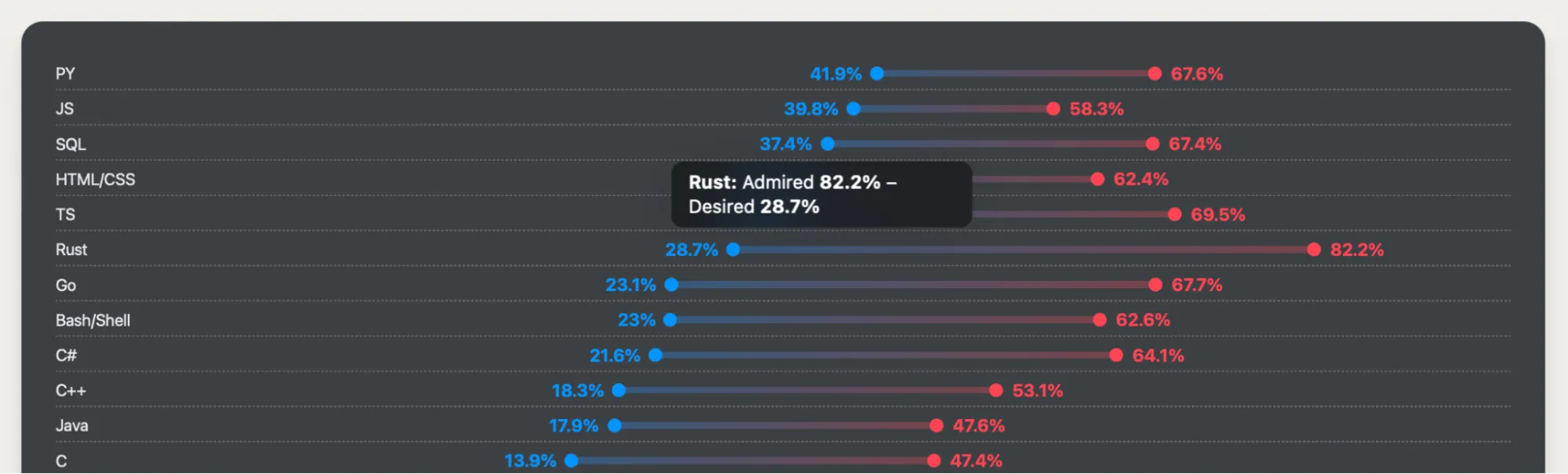
Admired and desired languages
“This year, too, Rust holds the title of the most-admired language, scoring 83%.” It’s also worth pointing out that its Desired percentage is quite high (28.7%), putting it in 6th place overall and 1st in terms of admiration.
Rust was chosen by 12.6% of respondents in answer to the question “In which programming, scripting, and markup languages did you do extensive development work during the past year, and in which would you like to work during the next year? (If you have worked with a language and want to keep doing so, tick both boxes in its row).”
That puts Rust in 14th place, and it can no longer be called a niche language (for comparison, Java has 30.3%).
2023 Survey
In 2023, Rust was once more the top pick among developers wanting to use a new technology (as it had been for the past 8 years), which points to strong interest among those not yet using it.
Rust kept its “most admired” title, with almost 85% of developers who had used it wishing to keep doing so.
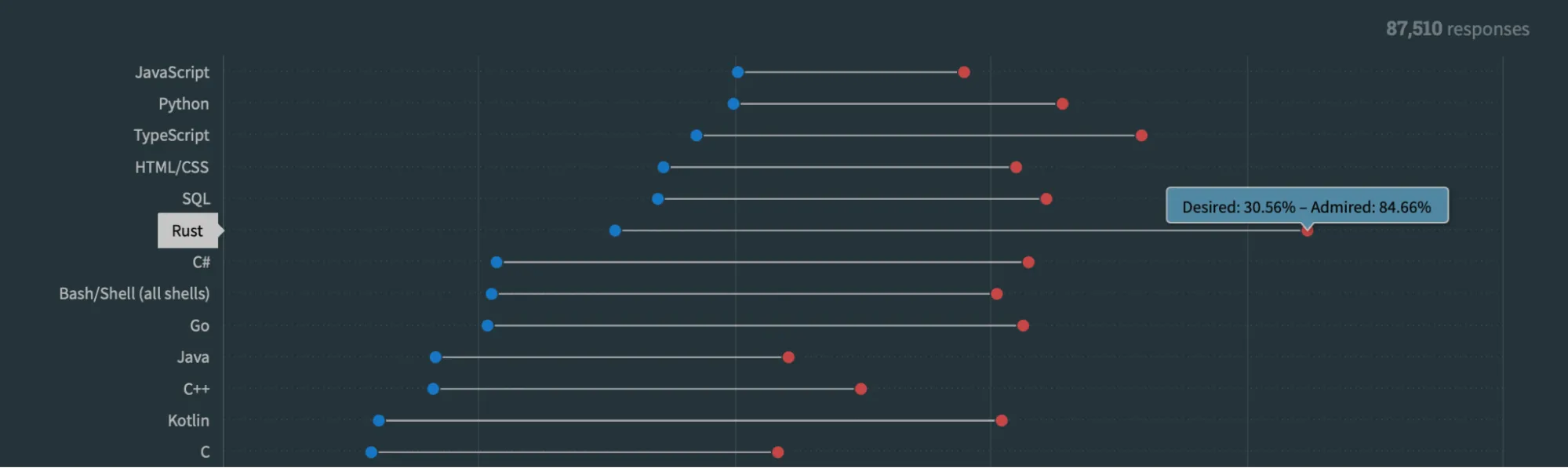
Admired languages
In the “Programming, scripting, and markup languages” ranking of commonly used languages, Rust came 14th with a 13.05% share.
2022 Survey
In 2022, 9.32% of respondents used Rust for extensive development work.
The survey showed that, for the seventh year in a row, Rust was the “most loved” language, with 87% of developers who had used it wanting to keep going.
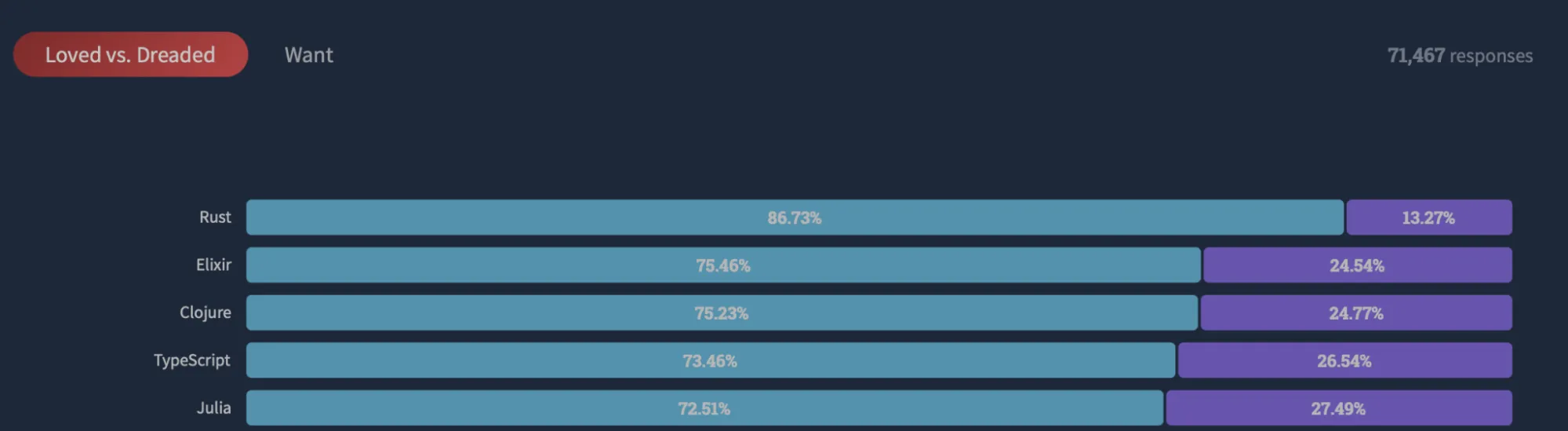
The most loved languages
Community
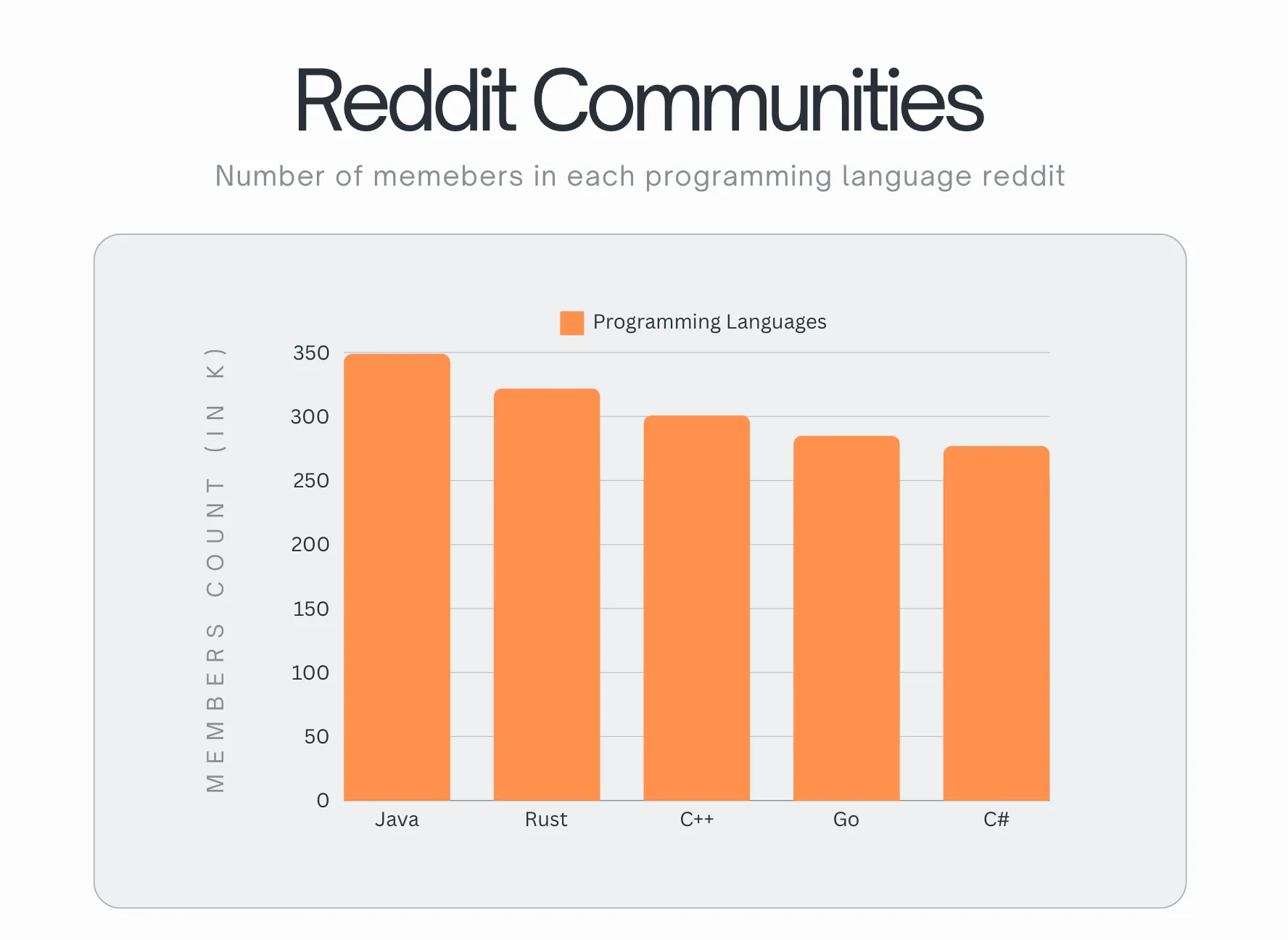
I looked only at several of the most popular programming communities on Reddit. Below you’ll find a link to each of them together with the number of members following their posts:
| Python | https://www.reddit.com/r/Python/ | 1.3M members |
| C++ | https://www.reddit.com/r/cpp/ | 301k members |
| Java | https://www.reddit.com/r/java/ | 349k members |
| C | https://www.reddit.com/r/cprogramming/ | 34k members |
| C# | https://www.reddit.com/r/csharp/ | 277k members |
| JavaScript | https://www.reddit.com/r/javascript/ | 2.4M members |
| Kotlin | https://www.reddit.com/r/Kotlin/ | 88k members |
| Rust | https://www.reddit.com/r/rust/ | 322k members |
| Go | https://www.reddit.com/r/golang/ | 285k members |
Rust’s community is very strong and still growing, nearly matching Java’s in size. I left Python and JavaScript out of the chart, since they are several times bigger than the other languages I examined. C is missing from the chart too, because its Reddit community is small in comparison with the rest.
Reddit Communities
Naturally, I only counted members of the main subreddits, but every programming language has further communities around it – for Rust, for example, learn_rust (https://www.reddit.com/r/learnrust/) with 31k members or game_dev(https://www.reddit.com/r/rust_gamedev/) with 40k members.
Rust Crates
Daily downloads

Number of users/teams that own a crate on crates.io

Two statistics worth keeping an eye on are how many Rust libraries are created each year and how many times those crates are downloaded from the crates.io website.
These statistics can be found on the lib.rs website, and they show steady growth, with downloads increasing 2x per year.
As of writing, 42,712 users or teams own a crate on crates.io, and the number of owners grows 1.2× per year.
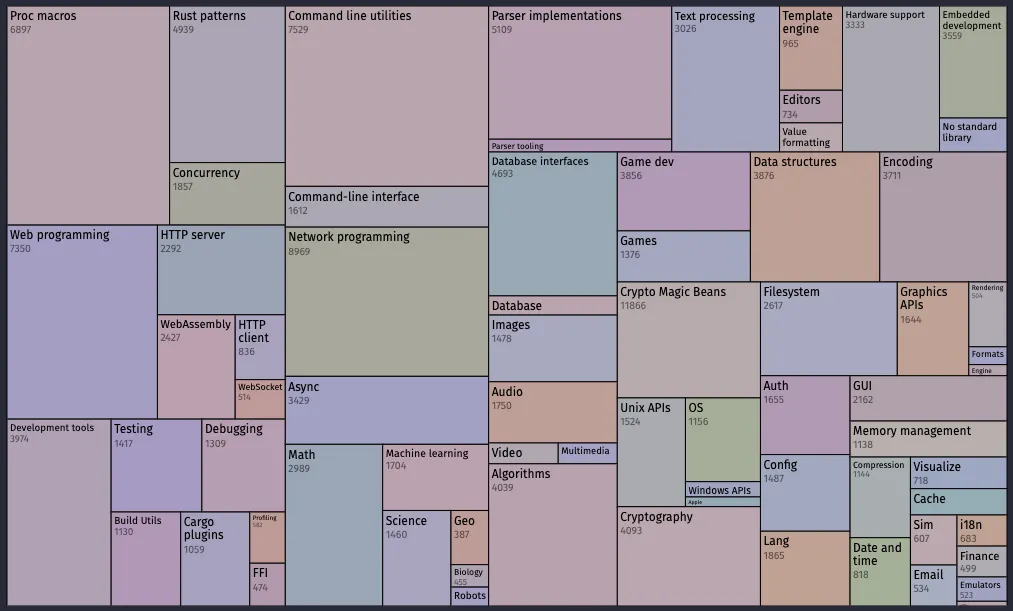
The same website lets you see in which categories Rust excels. Unsurprisingly, many of them relate to systems programming, but it’s worth noting how big the areas of web programming, http server and database-related crates are.
Advantages of the Rust programming language
Jobs
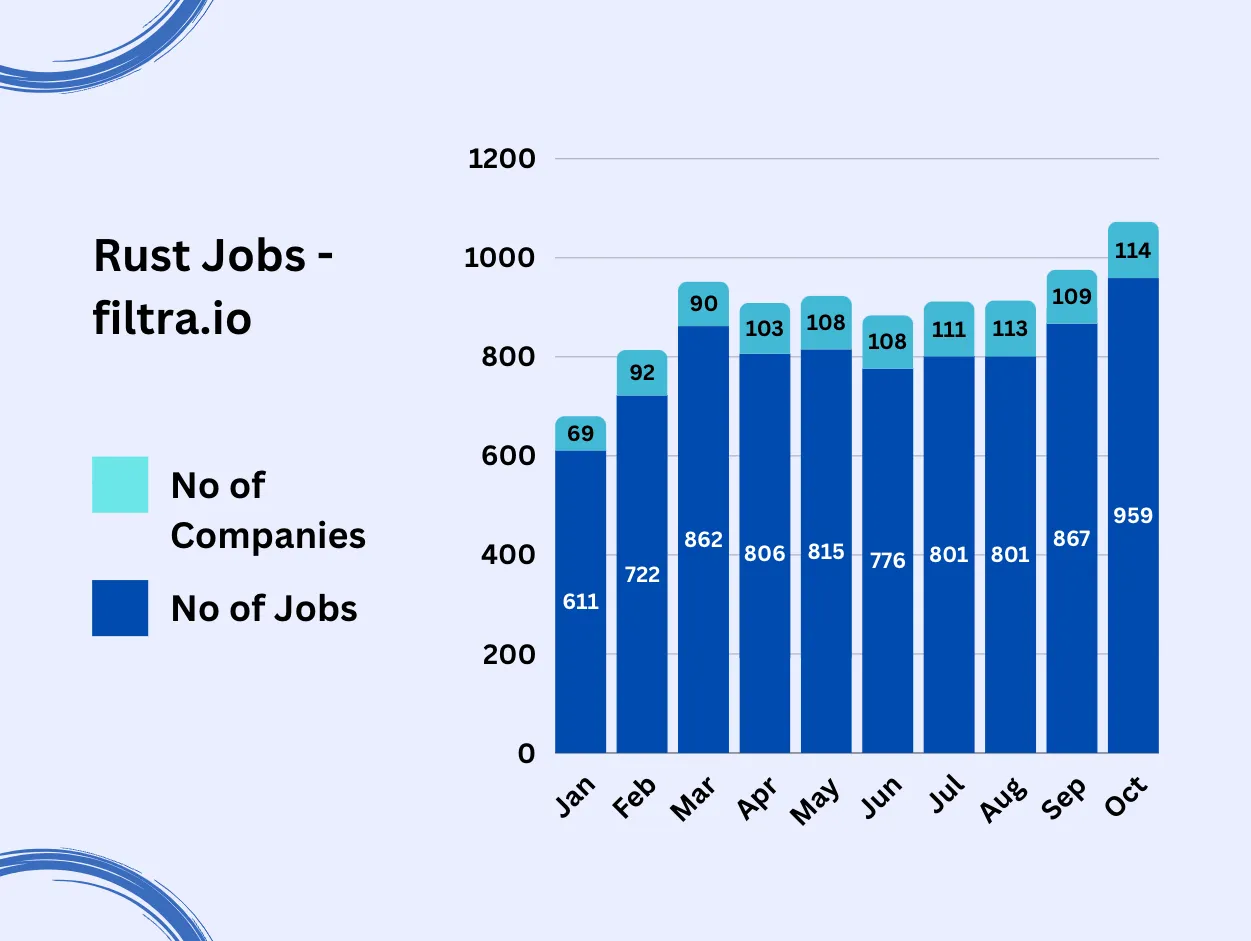
Finally, when discussing a language’s popularity and choosing a technology, the number of open Rust developer positions appearing across the internet matters a lot. The growth here is quite slow, but it is growth nonetheless (unlike for some more popular languages these days).
Rust jobs
Judging by what Filtra.io publishes on its website (https://filtra.io/rust/jobs-report/oct-24), Rust jobs on the market are trending upwards: every month (at least this year) there are either more companies searching for Rust developers or more open Rust developer positions (and sometimes both).
Wrap up
We could probably look at many other sources to see whether the language is getting more popular (recently published books, the number of new projects on GitHub, and so on). I’m sure, though, that they would paint a picture similar to the one above. The Rust ecosystem is growing – in terms of developers using it, the number of Rust libraries being created and downloaded, the size of the Reddit community alone, and, last but not least, the number of Rust jobs on offer.
If it’s up to you to choose the new technology for your project, or you’ve already made the choice but don’t have the resources – we’re here to help.