Big Picture Event Storming – taming the chaos
A Big Picture Event Storming session opens with a chaotic exploration whose aim is to surface as many domain events as possible. Afterwards, the participants jointly bring order to that chaos by arranging the events, eliminating duplicates, and cleaning up the process. Keep reading to find out how we dealt with the chaos in our Event Storming session on the device inventory process.
Chaos is regarded as the original state, the very first condition of the universe, from which everything else emerged. The line “In the beginning, Chaos arose” from Hesiod’s Theogony captures this idea perfectly. Although it comes from mythology, it fits the phenomena around us remarkably well.
The opening of a Big Picture Event Storming workshop is a good example. It begins with chaotic exploration, in which everything is unfamiliar, disorganized, and probably not fully understood. As the session goes on, participants learn more about the processes or domains under discussion, and the chaos is brought into order step by step.
In this article, I will explain how my colleagues and I began bringing order to chaos in our first Big Picture Event Storming session, during which we modeled the device inventory process.
Before it began
Ice breakers
Before the chaotic exploration part of the session kicks off, it is generally worth spending a moment on introducing participants and doing an ice-breaking exercise. People feel more at ease once they know who they will spend the coming hours with, and it brings some fun into the group. Usually, a short round in which each person introduces themselves is enough.
In remote sessions, it can be hard to use popular icebreakers, like showing the proper way to peel a sticky note. Still, it pays to suggest some activities that grab people’s attention, for instance asking everyone to name their favorite movie or the tastiest meal they have ever eaten. This loosens up the meeting and helps people connect, particularly when brief, interesting conversations spring up along the way.
As we know each other extremely well, we could leave this part out and go straight to the first phase of the Event Storming session
The goal of the Event Storming session
The goal of the Event Storming session should also be defined and made clear at the start, before any brainstorming. A session with no goal is pointless. Event Storming is not an end in itself – it is only a tool for reaching one.
Our main goal was to map how the device inventory process looks today. We wanted to dig into the details of how it really works. So we focused on how it operates now and deliberately left possible improvements aside for the time being. This knowledge will ultimately support us in building the domain model while we develop a system that properly backs this business process.
Mapping the current state is a typical goal of Big Picture Event Storming, because understanding the situation as it is forms the starting point for further discussion. Sessions of this type can, however, serve other purposes too, such as:
- Identifying pain points and bottlenecks in the process
- Exploring new features or services
- Aligning on a strategic direction
- Improving collaboration and understanding
- Planning and prioritizing work
- Estimating work
Domain events are what it’s all about
Before jumping into our chaotic exploration, let’s go over a bit of theory and present the most important building block of Event Storming, namely domain events.
Everything begins with an empty canvas on Miro. This is when we start filling it with meaningful information. But what exactly counts as “meaningful information”? What we care about is collecting the relevant domain events that take place in the process being workshopped.
“Relevance” is the key word, since in the end those domain events will serve to build the domain model. That said, we try not to burden the domain experts with this. The facilitator just asks everyone to produce every domain event that comes to mind. Sorting them, removing duplicates, and cleaning everything up comes later.
Event Storming defines a set of building blocks, each shown as a sticky note of a particular color. Sticking to these color codes isn’t required, but it is an unwritten rule to follow the common convention so that moving between sessions is easier. I’ll introduce these building blocks as we move through the session.
The first and most important building block is the domain event mentioned above. Events are shown as orange sticky notes, which are the basic elements used to describe the domain events happening in the process.
They ought to be phrased in the past tense, but we don’t make the domain experts do so at the start of the session. That way we avoid stifling their creativity with worries about the event’s form. There will be an opportunity to adjust and refine it later.
Sample domain events
Phase 1 – Chaotic exploration
Chaotic exploration is the first phase of an Event Storming session, and its main aim is to bring out as much information as possible, free from any need for order or structure. This phase accepts the natural complexity and messiness of real-life processes, letting participants freely voice and record what they know about the system being discussed. It is where divergent thinking happens, which serves to produce creative ideas by exploring a wide range of possible solutions. During this phase, we mostly use orange sticky notes to mark domain events.
Brain dumping
Our facilitator told us everything we had to know about domain events. He even put a sample event on the board to show how simple it could be, and prepared a legend of building blocks we could look back at. It was clearly the right moment to let the events pour out of our heads.
He started a 20-minute timer on Miro to give us some structure – not as a strict deadline, but rather as a gentle push to keep up the pace. One of the facilitator’s duties is to watch how participants are getting on and what the mood of the session is. Depending on what he sees, he can extend the time or finish as originally planned.
Each of us picked a spot on the canvas and started dropping events onto it. After about 15 minutes, the board was already covered in orange sticky notes:
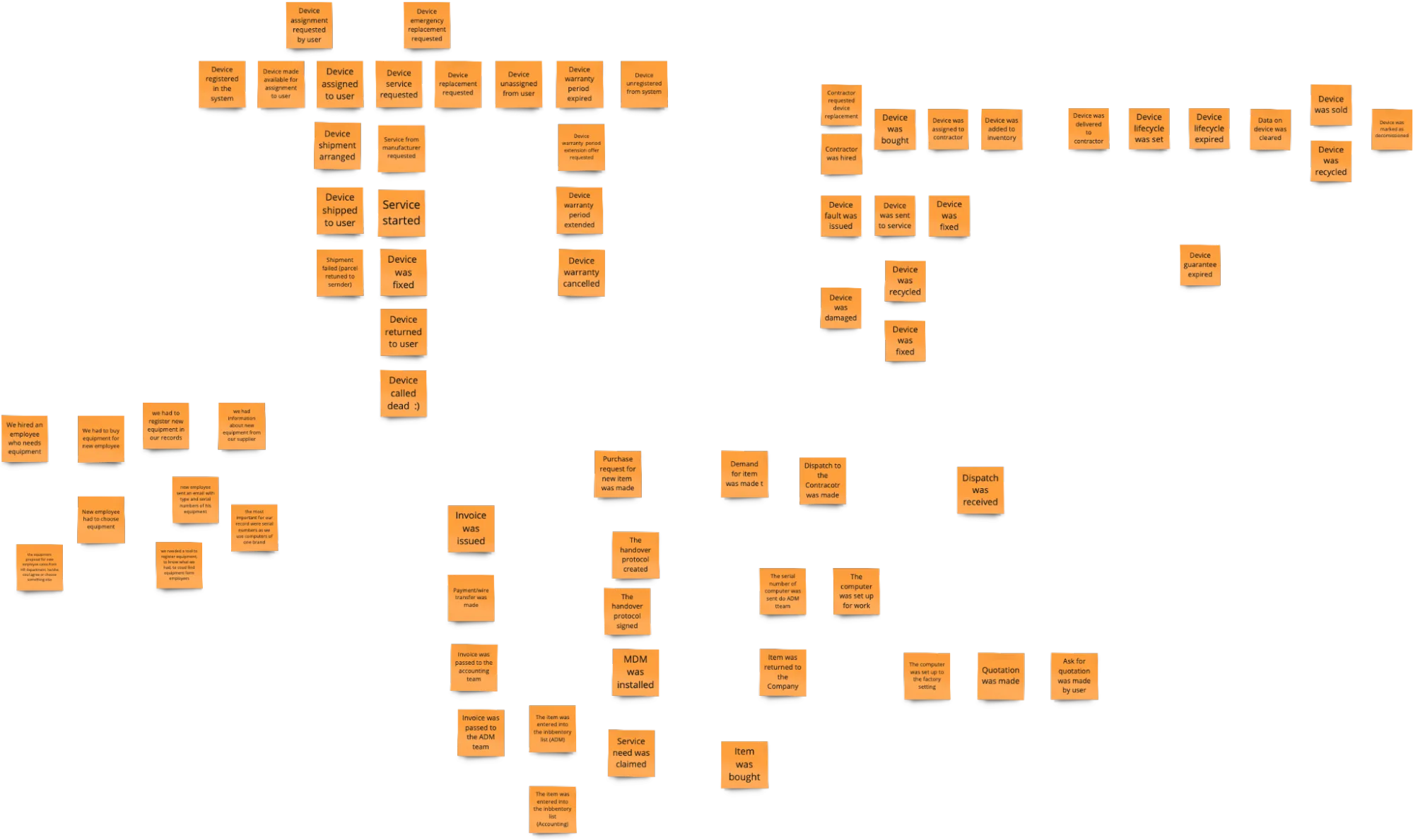
The Miro board once the chaotic exploration phase was over, CLICK to view it on Miro
Clearly, everything is rather messy and lacks order. Some sticky notes aren’t even written in the right tense. Some are full of abbreviations that may look like secret codes to part of the group. Others contain so much information that they read like short novels.
However, as I said earlier, this is all intended. We are in the divergent thinking phase. The last thing we want right now is for anybody to worry about making their events look perfect. Our main aim was to get as many events – or things that more or less resemble events – onto the board as possible. We wanted to capture ideas and insights about the process from every possible angle. And that is precisely what we accomplished.
Now comes the time to begin organizing this chaos. That’s what we dealt with in the second phase of our first Big Picture Event Storming session.
Phase 2 – Timeline enforcement
This emergent phase of the Big Picture Event Storming workshop is about bringing badly needed clarity and order into the creative chaos produced before. We go through the events we came up with to make sure everyone shares the same understanding of what each one means. This phase also covers removing duplicates and sorting the events.
In this crucial step, the joint brainstorming and divergent thinking of the earlier parts are shaped into a coherent story that follows the chronological order of events. It is also a good moment to bring up anything confusing, anything we are not entirely sure about, or any risks we notice in the process.
Getting the timeline right
We started this with a 40-minute slot. The facilitator led the way, trying to put the events in order while briefly talking through each one. These conversations made sure that we all understood what every event meant. At times we had to adjust the wording so it made more sense, or rewrite events that weren’t in the past tense or were simply too long. We also didn’t think twice about deleting duplicated events.
The aim was to put every event in its proper place in the sequence on the board. This was sometimes difficult, because not every event was clear to everyone. A few of the discussions took longer and involved both modelers and domain experts.
That’s why this phase lasted longer than we had first estimated. The facilitator had to extend the time more than once, but he always kept a close eye on the mood, proposing breaks whenever the course of the discussion or our energy required it.
Spotting the hot spots
At times our debates didn’t appear to be heading toward any conclusion. That was the moment to bring in so-called hot spots. They are another key building block of the Event Storming workshop, marking places where we are stuck, run into problems, lack knowledge, or see risks.
A hot spot typically marks an event we are uncertain about and for which we can’t find a satisfactory answer during the session. Often it means we have to ask people who aren’t in the room for their input. Hot spots are usually dealt with after the current session ends and before the following one begins, so that the blocker gets removed.
We normally mark hot spots with red or pink sticky notes so that they stand out as areas requiring additional attention.
Sample hotspots
Wrapping up: how it ended
Here’s what the board looked like when the first Big Picture Event Storming session was over:
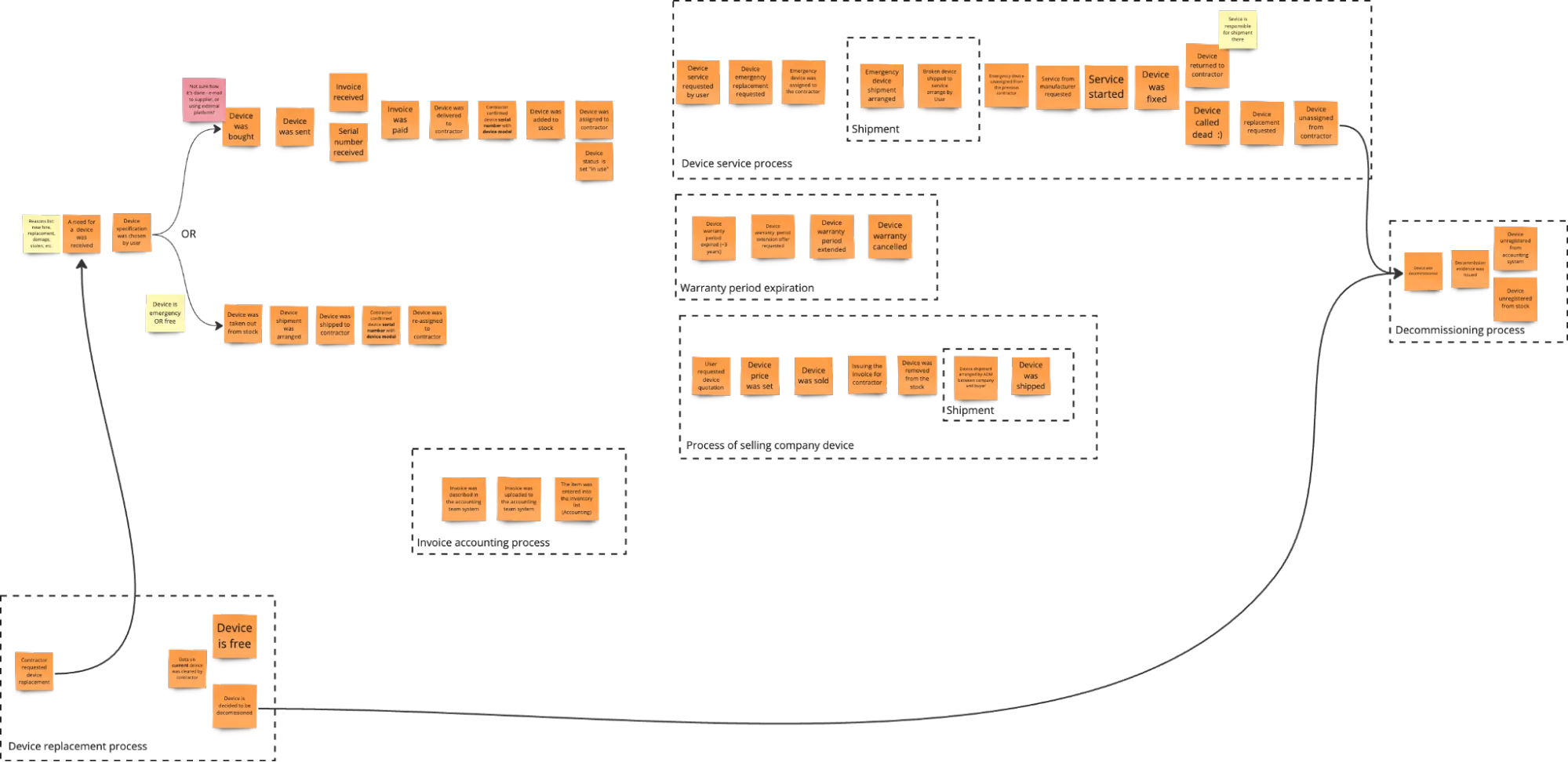
The Miro board once the timeline enforcement phase was over, CLICK to view it on Miro
As you can see, the events have more or less fallen into order. We adjusted the wording so that it better captures the essence of each business event. Compared with the chaos at the start, it looks much clearer now.
Only one hotspot remained that we couldn’t resolve at this point. That’s because our two domain experts were in the session and answered most of our questions. In my past experience, it’s more usual to finish with a whole bunch of red or pink sticky notes, particularly when dealing with complex business domains.
You may have spotted a few new elements: yellow sticky notes, arrows, and areas outlined with dotted lines. What’s great about Event Storming is how flexible it is. It doesn’t restrict us to a fixed list of elements. Event Storming exists to support our exploration, not to constrain our creativity.
Alberto Brandolini himself, the creator of Event Storming, compared it to a pizza. There is a basic base (the pizza’s dough), while the toppings – our tweaks and additions – are completely our choice. So it’s absolutely fine to add elements that help us achieve our goals.
We used yellow sticky notes to point out important facts that could easily slip our minds, such as the underlying reasons why someone needs a device. Arrows let us chart alternative paths or spots where the process splits. And the dotted lines? They worked great for visually setting apart the subprocesses that emerged in our discussions. At first we identified these sub processes within our main process:
- Device replacement process
- Device service process
- Decommissioning process
- Selling company device
- Invoice accounting process
- Warranty period expiration
The picture above shows that the first four processes are connected to the main process of providing the device to the contractor. The remaining two are more separate. This is, however, only our first take on it. We’ll explore it in more depth in the next session.
What the first Event Storming session produced
After almost five hours of intense discussion, we were all pretty worn out, but also excited and sharing a sense of achievement. The real question, though, is whether we actually reached the goal we had set at the start of the Event Storming.
The answer is: in part. So far, we’ve only gone through the first two phases of Big Picture Event Storming. Still, we all certainly understand this process far better than we did 5 hours earlier. We’ve straightened out the terminology used across the process, which lays the groundwork for the ubiquitous language, and brought to light a few hidden aspects that weren’t obvious at first. Above all, every one of us now understands much more deeply how things really work.
This gave us a solid foundation for continuing the session. By then we had already scheduled the next workshop, in which we intend to explore the reverse-narrative technique. It will help us uncover any gaps in the process. We also want to pinpoint the key actors and systems involved.
I’ll describe this and more in my next articles, which will show how the second session went. We’re also putting together a Q&A session with the two domain experts to hear their views and insights about this workshop. So, stay tuned.