SSE or WebSockets: A Comparison of Real-Time Communication Protocols
A look at Server Sent Events (SSE) and WebSockets that describes their features and compares them in the key categories that matter for modern web systems. Its goal is to help you decide which of the two technologies to use for real-time communication in web development.
In this article, I’d like to examine Server Sent Events (SSE for short) and WebSockets more closely. Both are solid, battle-tested ways of exchanging data.
I’ll begin by briefly characterizing each tool – what it is and what it provides. After that, I’ll compare them across eight categories that I consider the most important for today’s systems.
Here are the categories:
- Communication Direction
- Underlying Protocol
- Security
- Simplicity
- Performance
- Message Structure
- Ease of Adoption
- Tooling
Unlike in my earlier comparison of REST and qRPC, I won’t declare a winner or award points in each category. Instead, the Summary section contains a sort of TL;DR table that lists the main differences between the two technologies in the areas above.
The Why?
In contrast to REST, SSE and WebSockets are both more focused on specific use cases. Here, the main goal of both concepts is to provide a “real-time” communication channel. This narrower focus makes them less popular than REST, which is a more general, one-size-fits-all kind of tool.
Even so, SSE and WebSockets both open up an interesting range of possibilities and offer a bit of a change from the classic REST way of solving problems.
I think it’s worth knowing about them and making room for them in our toolbox, since they might prove useful someday, giving you a simpler answer to a fairly complex problem. This is especially true when you need “real-time” updates or when your app calls for a more push-oriented approach.
Apart from describing and comparing them here, I’d also like to help make them more popular.
What is WebSockets
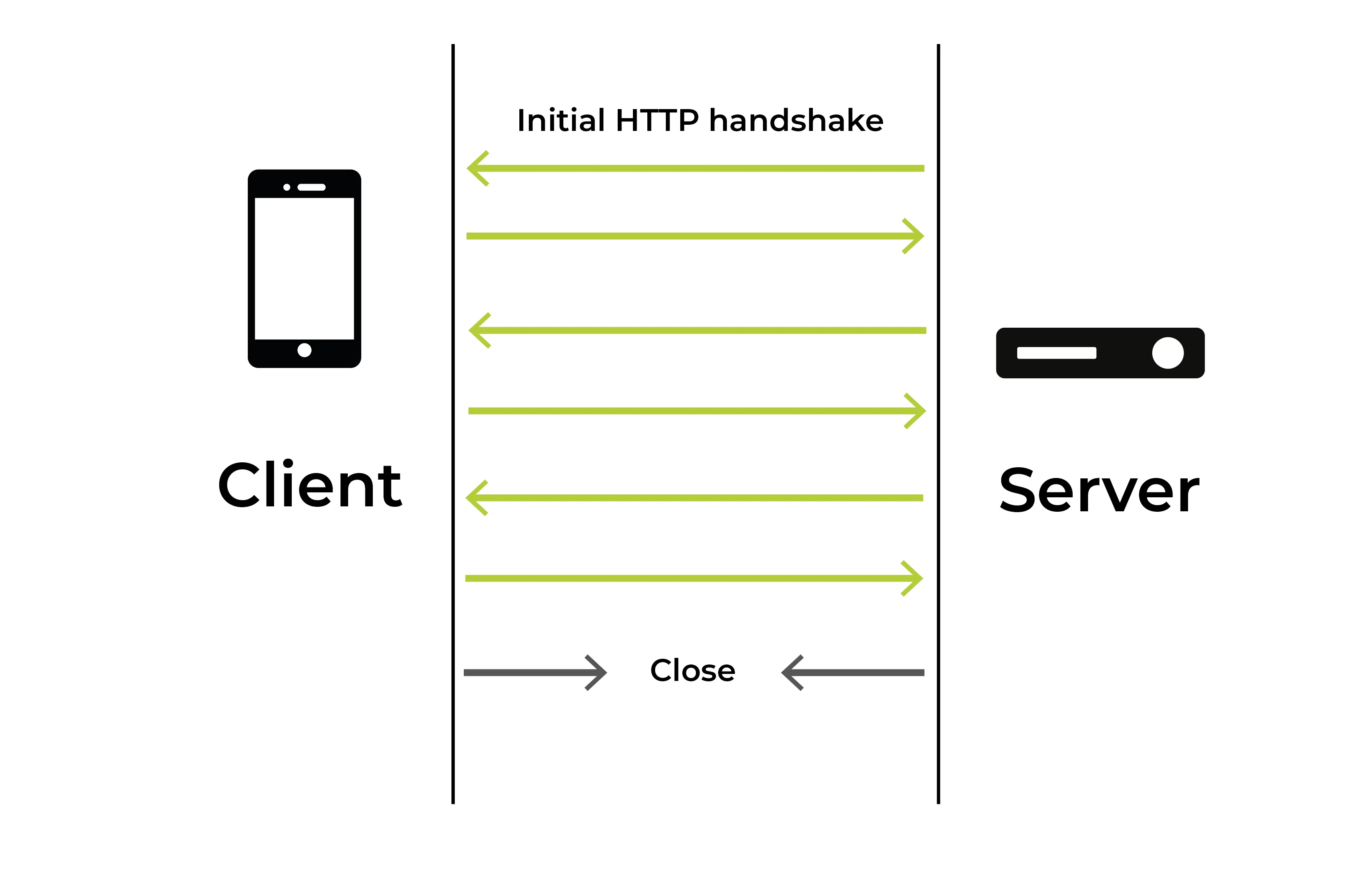
In a nutshell, it’s a communication protocol that enables bi-directional communication between a server and a client over a single, long-lived TCP connection. Because of this, we don’t need to keep pulling fresh data from the server; instead, the interested parties exchange data in “real-time”. Every message is either binary data or Unicode text.
The IETF standardized the protocol in 2011 as RFC 6455. The WebSocket protocol is separate from HTTP, yet both sit at layer 7 of the OSI model and rely on TCP at layer 4.
The protocol comes with its own prefixes, which work much like the http and https prefixes in HTTP:
- ws -> means that the connection is not protected with TLS
- wss -> means that the connection is protected with TLS
Moreover, non-secure WebSockets connections (ws) should not be opened from secure sites (https), and likewise, secure WebSockets connections (wss) should not be opened from non-secure sites (http).
At the same time, WebSocket is designed to run on HTTP ports 443 and 80 and supports HTTP concepts such as proxies and intermediaries. In addition, the WebSocket handshake relies on an HTTP upgrade header to switch the protocol from HTTP to WebSocket.
The main weakness of WebSocket as a protocol is security. Since WebSocket isn’t subject to the same-origin policy, CSRF-style attacks may become much easier.
What is Server Sent Events
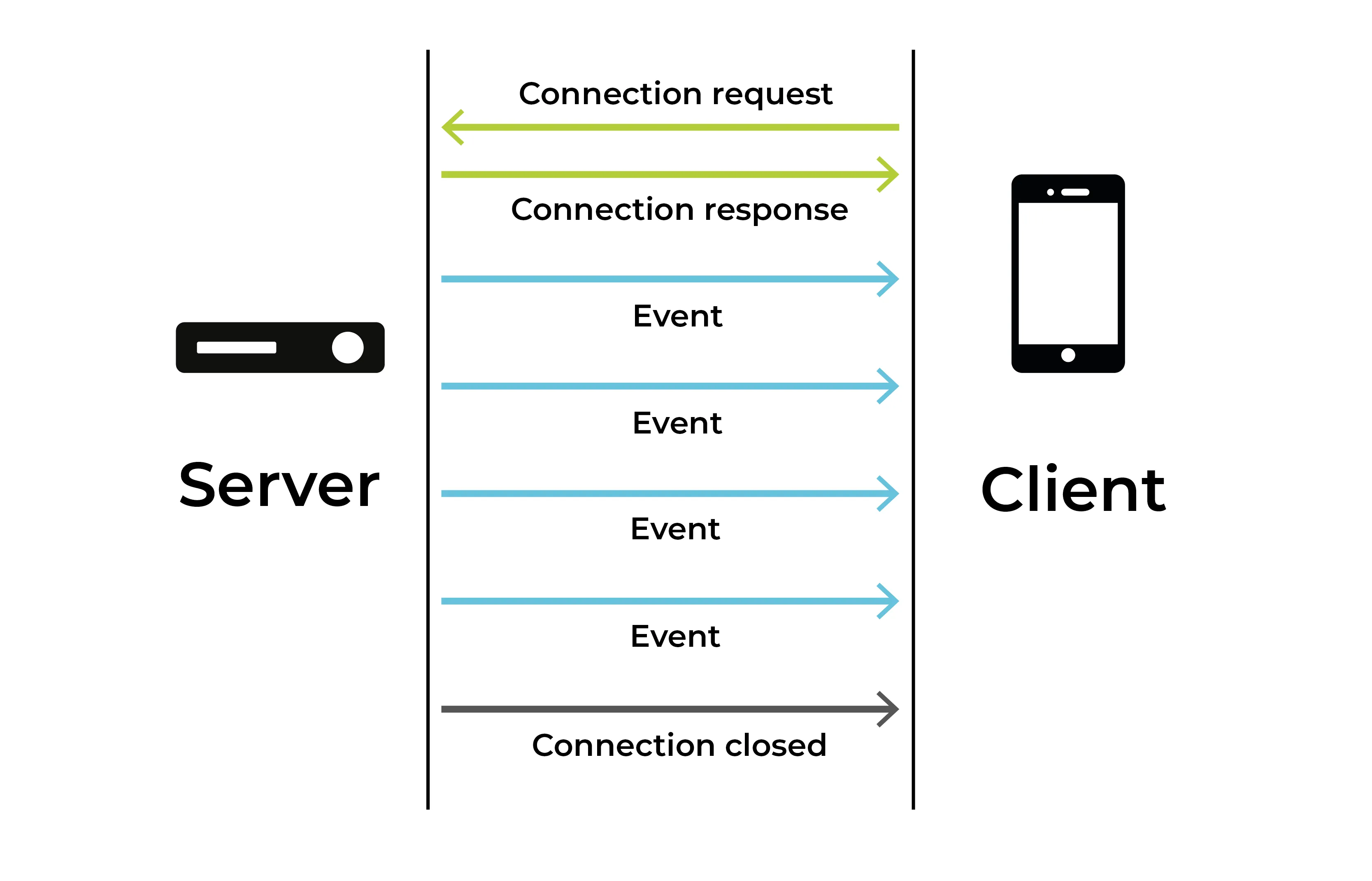
SSE is a technology that lets a web server push updates to a web page. It belongs to the HTML 5 specification and, like WebSockets, uses a single long-lived HTTP connection to deliver data in “real-time”. Conceptually, it is a fairly old technology, with theoretical foundations going back to 2004. The first attempt at implementing SSE was made in 2006 by the Opera team.
Most modern browsers support SSE – Microsoft Edge added support for it in January 2020. It can also make full use of HTTP/2, which removes one of SSE’s biggest problems by effectively lifting the connection limit enforced by HTTP/1.1.
By definition, Server Sent Events consist of two basic building blocks:
- EventSource -> an interface based on the WHATWG specification and implemented by the browser; it lets the client (here, a browser) subscribe to events.
- Event stream -> a protocol defining the standard plain-text format that events sent by the server have to follow so that the EventSource client can understand and propagate them.
Under the specification, events may carry arbitrary text data and an optional ID, and they are separated by newlines. They even have a MIME type of their own: text/event-stream.
Sadly, Server Sent Events as a technology is built to handle text-based messages only, and even though we can send events in a custom format, ultimately each message has to be a UTF-8 encoded string.
In addition, SSE offers two really interesting features:
- Automatic reconnection -> When the client disconnects unexpectedly, EventSource keeps trying to reconnect at intervals.
- Automatic stream resume -> EventSource automatically keeps track of the ID of the last message it received and sends a Last-Event-ID header automatically when attempting to reconnect.
The Comparison
Communication Direction
The most significant difference between them is most likely how they communicate.
- SSE offers one-way communication only – events can travel exclusively from the server to the client.
- WebSockets offers full two-way communication, letting the parties exchange information and respond to events coming from either side.
In my view, each approach has its advantages and drawbacks, along with its own set of suitable use cases.
If all you need is to push a stream of continuous updates to the client, SSE will be the better fit. If, however, you need to respond in some way to any of those events, WebSocket may serve you better.
In theory (and in practice), anything achievable with SSE can also be achieved with WebSockets, but at that point we get into questions of support, solution simplicity or security.
The following sections cover all of these areas and more. Moreover, using WebSocket for every case can be serious overkill, while a solution built on SSE may simply be easier to implement.
Underlying Protocol
This is another major difference between the two technologies.
- SSE is built entirely on HTTP and supports both HTTP/1.1 and HTTP/2.
- WebSocket, by contrast, uses a custom protocol of its own – surprise, surprise – the WebSocket protocol.
For SSE, using HTTP/2 fixes one of its main problems – the limit on the maximum number of parallel connections. The HTTP/1.1 specification restricts how many parallel connections can be open.
This can result in an issue known as head-of-line blocking. HTTP/2 tackles it by introducing multiplexing, which eliminates HOL blocking at the application layer. Head-of-line blocking can still happen at the TCP level, though.
I covered the WebSocket protocol in some detail a few paragraphs earlier, so I’ll only repeat the key points here. The protocol differs somewhat from classic HTTP, even though it relies on an HTTP upgrade header to set up the WebSocket connection and effectively switch communication protocols.
That said, it is also built on top of TCP and is fully compatible with HTTP. Its biggest weakness is security.
Simplicity
Generally speaking, an SSE-based integration is easier to set up than a WebSocket one. The main reason is the kind of communication each technology uses.
SSE’s one-directional nature and its push model make it conceptually simpler. Add the automatic reconnection and stream continuity support it provides out of the box, and the list of things we need to look after becomes much shorter.
Given all these features, SSE can also be seen as a way of loosening the coupling between client and server. All clients need to know is an endpoint that emits the events.
In this setup, however, the client can only receive messages, so sending any kind of information back to the server requires a separate communication channel, which can make things considerably more complex.
With WebSocket, matters are a bit more complicated. To begin with, we have to handle upgrading the connection from HTTP to the WebSocket protocol. Although this is the easiest part, it’s one more thing to keep in mind.
The second issue stems from the bi-directional nature of WebSockets. We need to manage each connection’s state and deal with every exception that may arise while a message is being processed. What happens, for instance, if processing one of the messages throws an exception on the server side?
Then there is the matter of handling reconnections, which with WebSockets is entirely up to us.
There’s also an issue that affects both technologies – long-running connections.
Both of them have to keep long-lived connections open in order to deliver a continuous stream of events.
Handling such connections, particularly at scale, can be difficult, since resources can run out fairly fast. On top of that, they may need special settings such as longer timeouts and are more vulnerable to any network connectivity issues.
Security
As far as security goes, SSE is nothing special, since it uses the plain old HTTP protocol for transport. Every usual HTTP strength and weakness applies to SSE – it’s that simple.
For the WebSocket protocol as a whole, though, security is among its greatest weaknesses. To begin with, there is no Same Origin Policy at all, so nothing restricts where we can connect to via WebSockets.
There’s even a dedicated kind of attack designed to exploit this weakness: Cross-Origin WebSocket Hijacking. If you’d like to explore Same Origin Policy and WebSocket in more depth, you might find this article interesting. Apart from that, WebSockets has no protocol-specific security holes.
In my opinion, all the standard rules and security best practices apply to both, so just stay careful when implementing your solution.
Performance
In my view, the two technologies are evenly matched when it comes to performance. Neither of them imposes any theoretical performance limits by itself.
That said, SSE may be quicker in terms of raw messages sent per second, since it more or less follows a fire-and-forget principle, while WebSocket also has to deal with responses from the client.
What can really affect the performance of either is the underlying client used in our application and how it is implemented. Investigate, read the documentation, run your own stress tests, and you may gain some very interesting insights into the tool you use or your whole system.
Message Structure
Message structure is likely one more of the key differences between the protocols.
As mentioned earlier, SSE is a purely text-based protocol. Messages can have various formats and contents, but ultimately all of them become UTF-8 encoded text. Complex formats or binary data are not an option.
WebSocket, in contrast, supports both text and binary messages, which lets us send images, audio or ordinary files. Just bear in mind that handling files can introduce considerable overhead.
Ease of Adoption
On this front, the two technologies are at a very similar level. Many tools exist for adding WebSockets and Server Sent Events support, on both the client and the server side, from the SSE perspective.
Most mature programming languages offer more than one library of this kind. Without going into too much detail, I’ve put together a table listing the basic libraries that add WebSockets and SSE support.
| Language | Server Sent Events | WebSockets |
|---|---|---|
| Java | Spring (SSE), Quarkus (SSE) | Spring (WebSockets), Quarkus (WebSockets) |
| Scala | Akka (SSE), Play (SSE) | Akka (WebSockets), Play (WebSockets) |
| JavaScript | EventSource, total.js (SSE) | Socket.io, total.js (WebSocekts) |
| Python | Starlette | FastAPI |
Clearly, there are lots of mature options for adding SEE or WebSockets integration to our application. Naturally, this is just a tiny sample of all the available libraries – there are many more. The actual challenge may lie in picking the one that best matches your specific use case.
Tooling
Automated Tests
To my knowledge, neither SSE nor WebSockets has dedicated automated testing tools. You can, however, get similar functionality fairly easily using Postman and collections.
Postman supports both Server Sent Events and WebSockets. With a bit of magic from Postman collections, you can build a test suite that checks whether your endpoints work correctly.
Performance Tests
For Performance Tests, you can choose either JMeter or Gatling. To my knowledge, they are the two most mature tools for general performance testing. Naturally, both support SSE (JMeter, Gatling) as well as WebSockets (JMeter, Gatling).
Other tools are available too, such as sse-perf (SSE only), Testable or k6 (WebSockets only).
Of all these tools, my personal recommendation is Gatling or k6. Both appear to offer the best user experience and to be the most production-ready.
Documentation
To some extent, no tools exist that are dedicated exclusively to documenting SSE or WebSockets. There is, however, a tool named AsyncAPI that can serve exactly this purpose for both concepts.
Sadly, OpenAPI does not appear to support SSE or WebSockets.
Summary
As promised, the summary is short and simple – see below.
In my opinion, the table above gives a neat and concise overview of the subject and of the whole article.
The key difference is the Communication Direction, since it defines what a given technology can be used for. It is likely to weigh most heavily when picking one over the other.
Message structure can also matter a lot when deciding on a particular communication method. Supporting only plain text messages is a major limitation of Server Sent Events.
Thanks for reading.