Java native frameworks compared from the community perspective
This guide describes which non-technical factors are worth investigating before you pick a technology.
In this installment of our „Comparison of Java Frameworks” series, we attempt to assess the Micronaut and Quarkus frameworks by how strong their communities are. This guide describes which non-technical factors are worth investigating before you pick a technology.
Who should read this blog post?
It is aimed at people who are thinking about going with one of the alternatives to Spring, namely Quarkus or Micronaut, and who want to know which one is the better long-term investment, setting the technical details aside. On top of that, we point out below which non-technical aspects deserve attention whenever we pick any other dependency for our application.
Why do the community aspects of a framework matter?
Let’s begin with the reasons for looking into a community before adding any dependency to our software. A handful of factors can help here:
- Who wrote it? Well-regarded authors are more likely to feel responsible for the tool they deliver, which can translate into longer support.
- How often do patches come out? If the dependency you are considering was last released several years ago, that may be a warning sign that it is not the right pick and that you are heading for trouble.
- What does issue resolution look like? If the framework’s repository (e.g. Github) is full of old problems that maintainers never answered, you can expect to end up in the same position when you run into trouble yourself.
- How many developers use it, and how many organizations have built it into their products? The more widely developers use a tool, the better your odds of finding a fix for the exact problem you have just hit, or of getting a fast answer to your question, e.g., on StackOverflow – a big plus when the official documentation offers no solution.
How do we assess it, then? Let’s put numbers on it!
To do this, we picked a few metrics that can characterize frameworks from angles other than the technical one. The data used in the analysis below was gathered in April 2023.
GitHub metrics
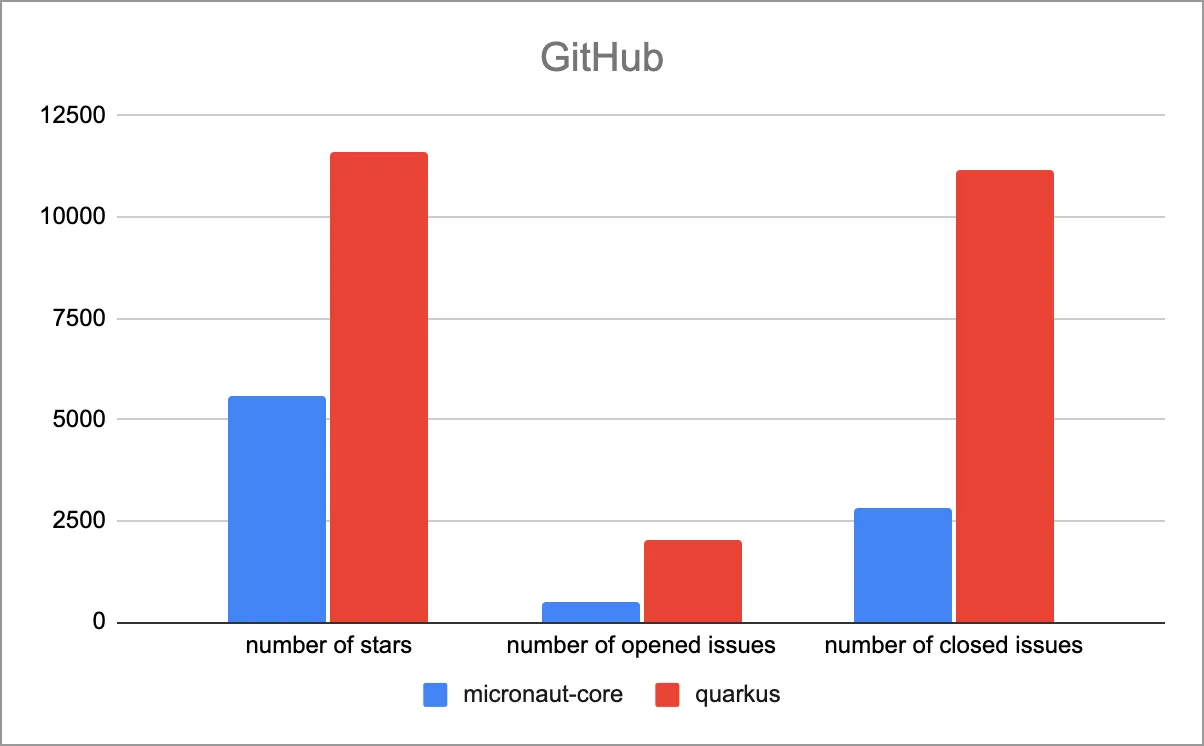
To start, let’s look at the figures from the GitHub repositories of each framework:
| micronaut-core | quarkus | |
|---|---|---|
| stars | 5600 | 11600 |
| open issues | 497 | 2004 |
| closed issues | 2801 | 11149 |
| closed-to-open issues ratio | 5,63 | 5,56 |
It is immediately clear that Quarkus leads in every GitHub metric, with Micronaut coming second. Quarkus has twice as many stars as Micronaut, and stars are commonly seen as a way of thanking the repository’s maintainer for their work. The more telling metrics are the counts of open and closed issues and the ratio between them. That ratio is almost identical, which suggests that the Quarkus and Micronaut maintainers are equally eager to fix issues and support users, even though Quarkus scores higher on every individual metric. That is an encouraging sign.
Release cadence
It is immediately clear that Quarkus leads in every GitHub metric, with Micronaut coming second. Quarkus has twice as many stars as Micronaut, and stars are commonly seen as a way of thanking the repository’s maintainer for their work. The more telling metrics are the counts of open and closed issues and the ratio between them. That ratio is almost identical, which suggests that the Quarkus and Micronaut maintainers are equally eager to fix issues and support users, even though Quarkus scores higher on every individual metric. That is an encouraging sign.
| micronaut-core | quarkus | |
|---|---|---|
| first release date | 2018-05-29 | 2018-12-19 |
| latest release date | 2023-04-04 | 2023-04-04 |
| total number of releases | 154 | 225 |
| average days between releases | 11,5 | 6,96 |
As noted before, how often new versions ship is a key indicator of a dependency’s health. The figures above show that both frameworks release at a remarkably fast pace. Quarkus puts out a new release roughly every week on average, while Micronaut does so every 11.5 days – an excellent result. We can safely say that contributors keep the codebase well maintained and continuously updated.
StackOverflow metrics
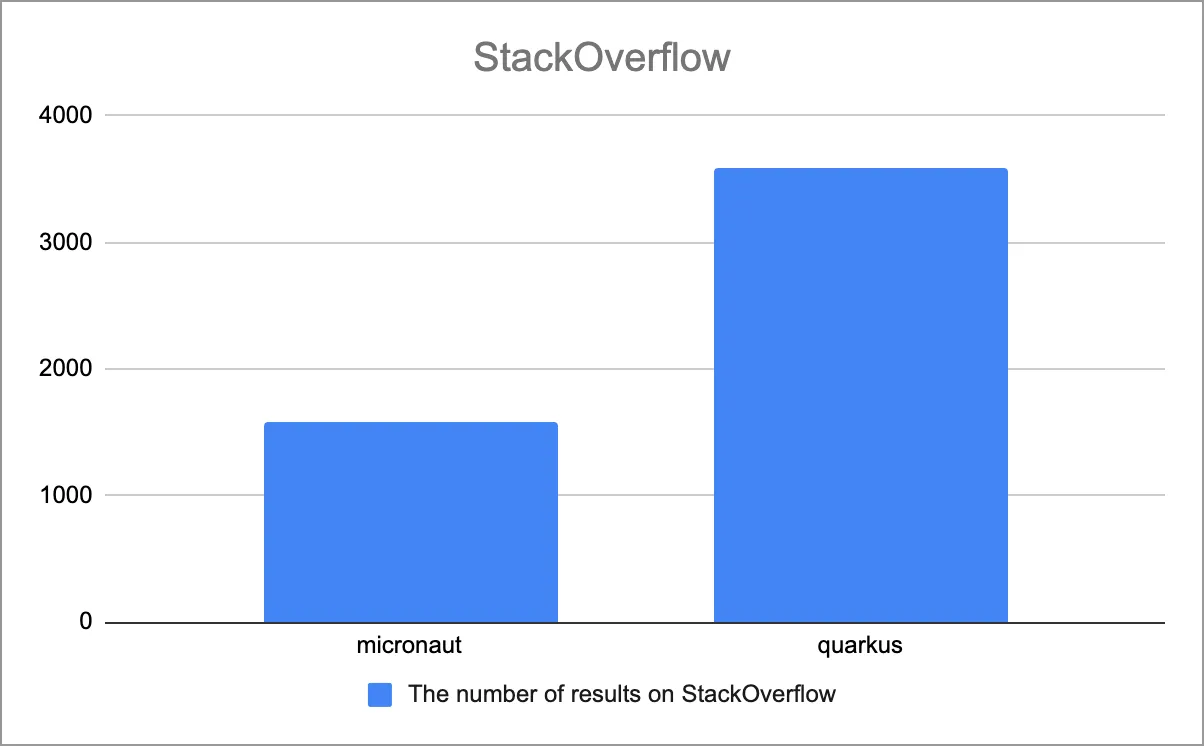
The tag-based search results on StackOverflow appear to line up with the GitHub numbers discussed earlier. Quarkus returned almost 2.3 more results on StackOverflow than Micronaut.
| micronaut | quarkus | |
|---|---|---|
| Results on StackOverflow | 1581 | 3593 |
Google Trends
Now let’s examine how popular each framework has been since 2018. We obtained this data from Google Trends.
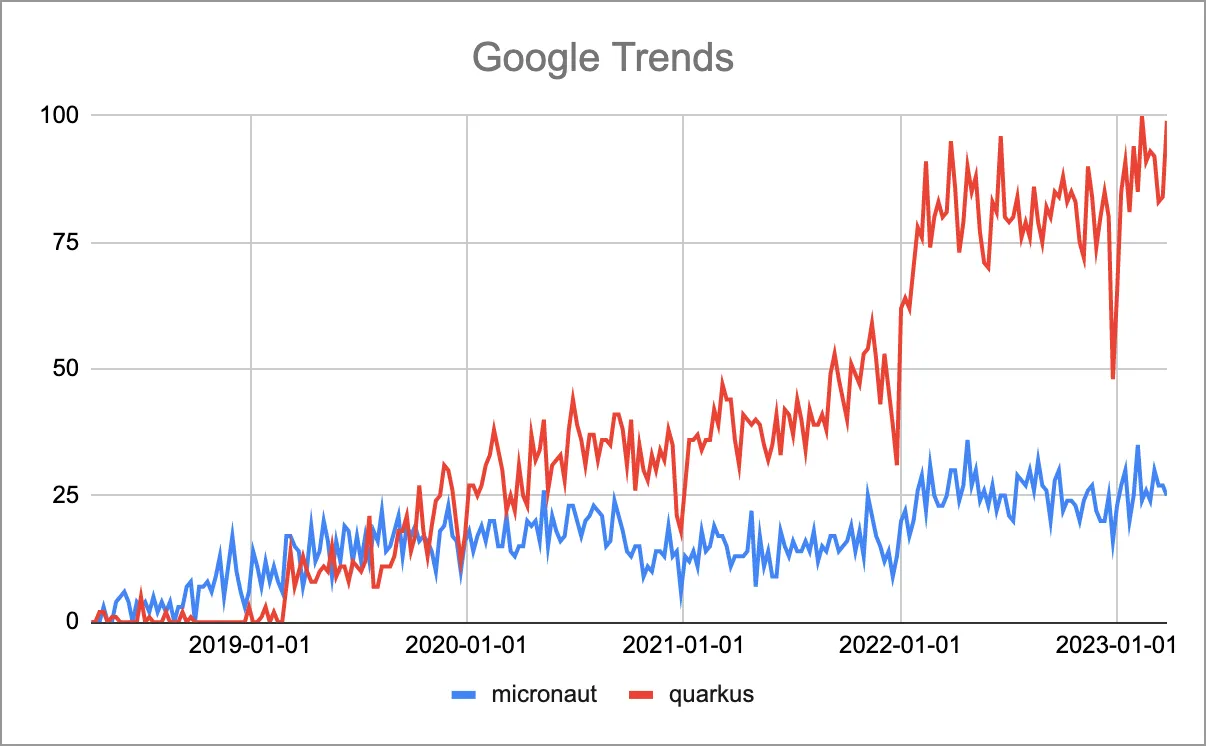
As you can see, Quarkus overtook Micronaut in popularity in 2020, and its lead keeps widening. Micronaut is gaining popularity as well, just not as fast as Quarkus.
JVM Ecosystem Report 2021
Judging by the JVM Ecosystem Report 2021, Quarkus seems to hold a firm position in its rivalry with Micronaut. How this will develop is hard to foresee, particularly now that Spring Native has given way to official native support in Spring Boot 3.
Linkedin metrics
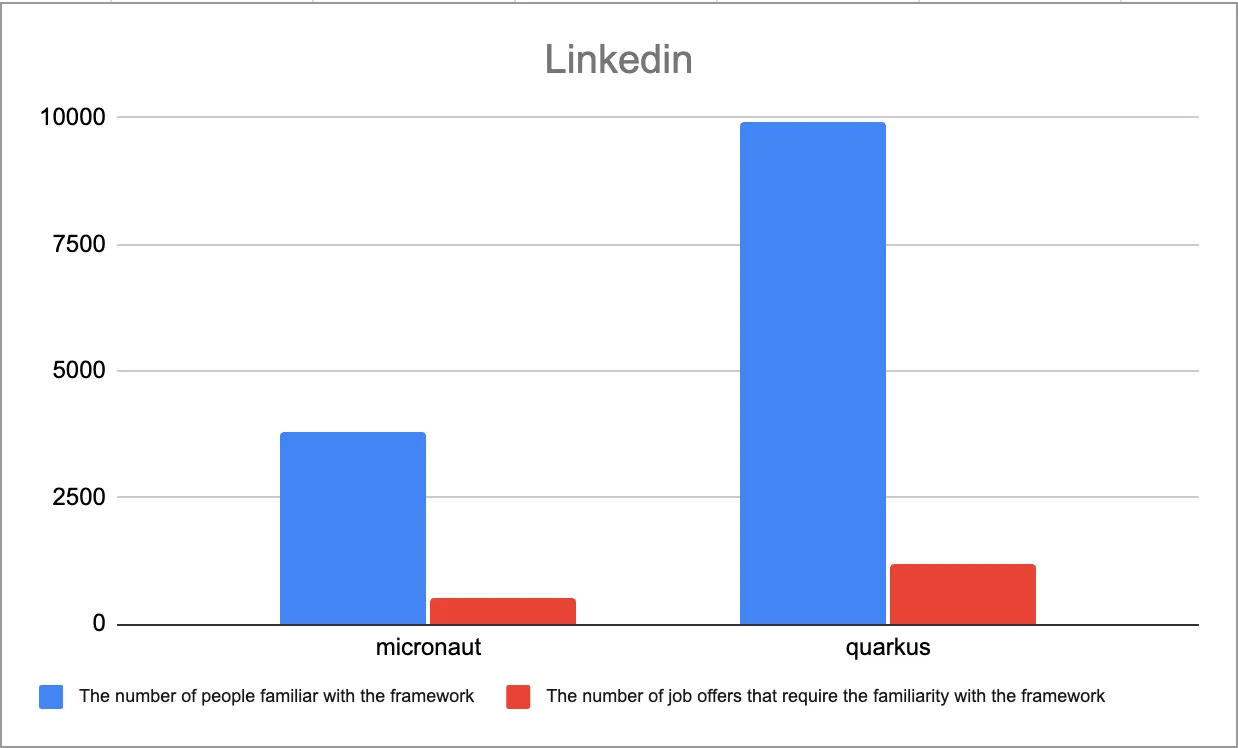
Since these frameworks have been on the market and discussed for several years, we can now judge them by how many people know them and how many organizations have adopted them in their systems. Organizational adoption can correlate with the number of job postings that list these technologies as required skills. To gather these figures, we searched Linkedin for people with the relevant skills and for job postings that ask for them.
| micronaut | quarkus | |
|---|---|---|
| People who know the framework | 3800 | 9900 |
| Job postings that require knowledge of the framework | 523 | 1207 |
Plenty of people appear to know both technologies, with Quarkus clearly ahead, yet when it comes to job postings requiring these frameworks, the gap between them is much smaller. For some reason developers favour Quarkus over Micronaut, although the job market does not show a comparable difference in demand. For organizations assessing a proposed technology, the availability of specialists who know it is a strong signal. It often even determines whether a technology makes it into production code. Naturally, we are aware that Spring is the undisputed king of Java frameworks. We chose to concentrate on alternatives to Spring so as not to blur the picture of newer, less widely adopted frameworks. Spring is without question several orders of magnitude more popular, and including it would have made the charts unreadable. For instance, right now almost 4 140 000 people on Linkedin say they know Spring Framework, about ~418 times more than Quarkus. As we said earlier, we are keeping a close eye on things given the arrival of Spring Native, which may soon extend Spring’s dominance by grabbing its share of the pie from the frameworks that support native compilation.
And the documentation?
Both frameworks offer well-maintained documentation. A wealth of tutorials in the ‘Getting started with …’ series makes it easy to get into the technologies and implement concrete use cases. The quarkus.io and micronaut.io websites are genuine treasure troves of knowledge presented in an easy-to-digest way. Each framework also runs its own blog and podcast, so keeping up with the news is easier.
Who is behind them?
Micronaut was created by Graeme Rocher, who is also known as the author of the Grails framework and who now works as an architect at Oracle Labs, devoting all his effort to developing Micronaut. Quarkus is officially created by Red Hat. The people designing both frameworks are fairly called elite, which is a good omen for the future development and maintenance of both solutions.
Which framework should we pick, then?
Naturally, it is more complicated than we would wish. Trends and the metrics we gathered show Quarkus as the more popular option, which may tempt us to choose it, but these should serve only as a hint when making the decision. Above all, we should select tools to meet specific needs rather than because they happen to be in fashion. What matters is understanding the strengths, weaknesses and capabilities of each tool before tying ourselves to it for a long time – perhaps for good.