The ways companies put big data to use
Discover how Big Data analytics leads to better decisions and strengthens what business processes can do.
Internet services and devices gather and keep an enormous quantity of information touching every aspect of our lives. Businesses collect that data and use it to innovate and gain an edge over the competition. It is an intricate puzzle that can reveal the secrets of our past, present, and future.
I’ll begin this article by briefly explaining the key terms connected with Big Data. After that, we’ll move to the article’s main topic: how do companies use Big Data? We’ll look at how Big Data analytics leads to better decisions and strengthens what business processes can do.
First, though, the most basic question.
What is Big Data?
Big Data means the huge and varied information produced in a digitally connected world. What sets Big Data apart is described by the 3Vs: volume, velocity, and variety. Some definitions include two more Vs – veracity and value – for a total of 5V. Let’s examine them more closely.
Big Data comes in a volume so massive that it goes beyond what traditional data management tools can handle. As a result, processing and analyzing it effectively with conventional methods is difficult or outright impossible.
It also displays considerable variety: it arrives in different formats and from many sources, which makes it complicated and demanding to work with. It spans a broad range of data types, both structured and unstructured – text, images, videos, sensor readings, social media interactions, and more.
Velocity describes the unprecedented pace at which Big Data is produced and refreshed, with information flowing in real-time from countless sources.
Value describes how meaningful Big Data is from a business perspective and what insights it can potentially yield. In this enormous ocean of information, the real value comes from being able to analyze and interpret the data in order to obtain meaningful insights and uncover patterns that were previously hidden.
Finally, veracity is the dimension of Big Data concerned with how reliable and trustworthy the data is. Given the huge volume of data coming from varied sources, guaranteeing its quality and accuracy turns into a major challenge. The data may contain errors, inconsistencies, or biases, which – if left unaddressed – can result in misleading or wrong conclusions.
A glimpse of history
The early days of the Internet created unprecedented opportunities for data analysis. Web companies like Yahoo, Amazon, and eBay began collecting data on customer behavior by examining click rates, user locations derived from IP addresses, or the subsites people visited. The amount of collected data grew fast, and businesses required new, innovative tools to make use of it.
The Oxford English Dictionary added the term Big Data in 2013, but the phrase itself is considerably older. It was coined by Roger Mougalas in 2005 to describe large data sets that were nearly impossible to manage with the tools of that time. That same year, Yahoo released Hadoop, an open-source distributed computing framework. This groundbreaking software made it possible to process data too large for a single machine. Hadoop is made up of three main components: a distributed file system (HDFS), a resource manager (YARN), and a processing engine (MapReduce). The Hadoop ecosystem soon grew to include numerous related tools: Apache Pig (released in 2006) – a high-level data-flow language, Apache Hive (2010) – an SQL-like query language for data warehousing, HBase (2009) – a NoSQL database running on HDFS, and plenty of others.
Hadoop remains in use today. Its processing engine, MapReduce, has become less popular since Spark came out in 2014. Spark was built to address some of MapReduce’s limitations, above all by introducing in-memory operations that make data processing tasks much faster.
Nowadays, starting out with Big Data is easier than ever, as cloud providers offer a range of services and solutions built specifically for processing, storing, and analyzing huge amounts of information. These offerings let organizations of any size take on Big Data challenges without large hardware investments or complicated infrastructure management.
How do we store Big Data?
Gathering Big Data requires selecting a data storage architecture that fits the particular needs and properties of the data.
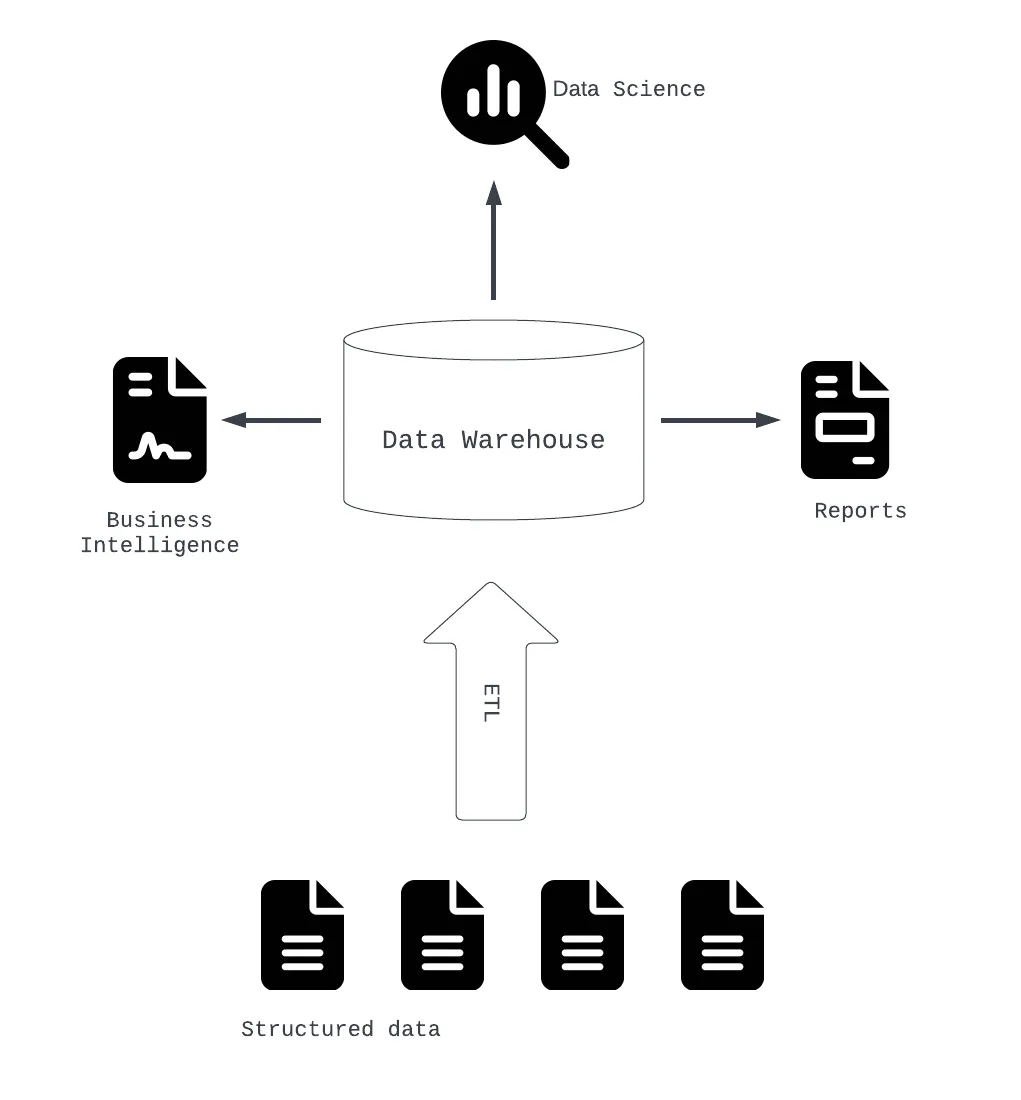
Data warehouses have traditionally been the dominant way to store and manage data. They offer a central repository for structured data coming from many sources. Before data is loaded into the warehouse, it is usually cleaned and transformed through the ETL (Extract, Transform, Load) process. The warehouse keeps data according to a predefined star or snowflake pattern schema. Warehouses are optimized for analytical queries and give a structured, consistent view of the information. Their greatest drawback is the rigidity of the schema: it must be designed upfront, which makes warehouses less adaptable when the schema of incoming data changes. ETL also adds processing overhead and can consume a lot of time and resources.
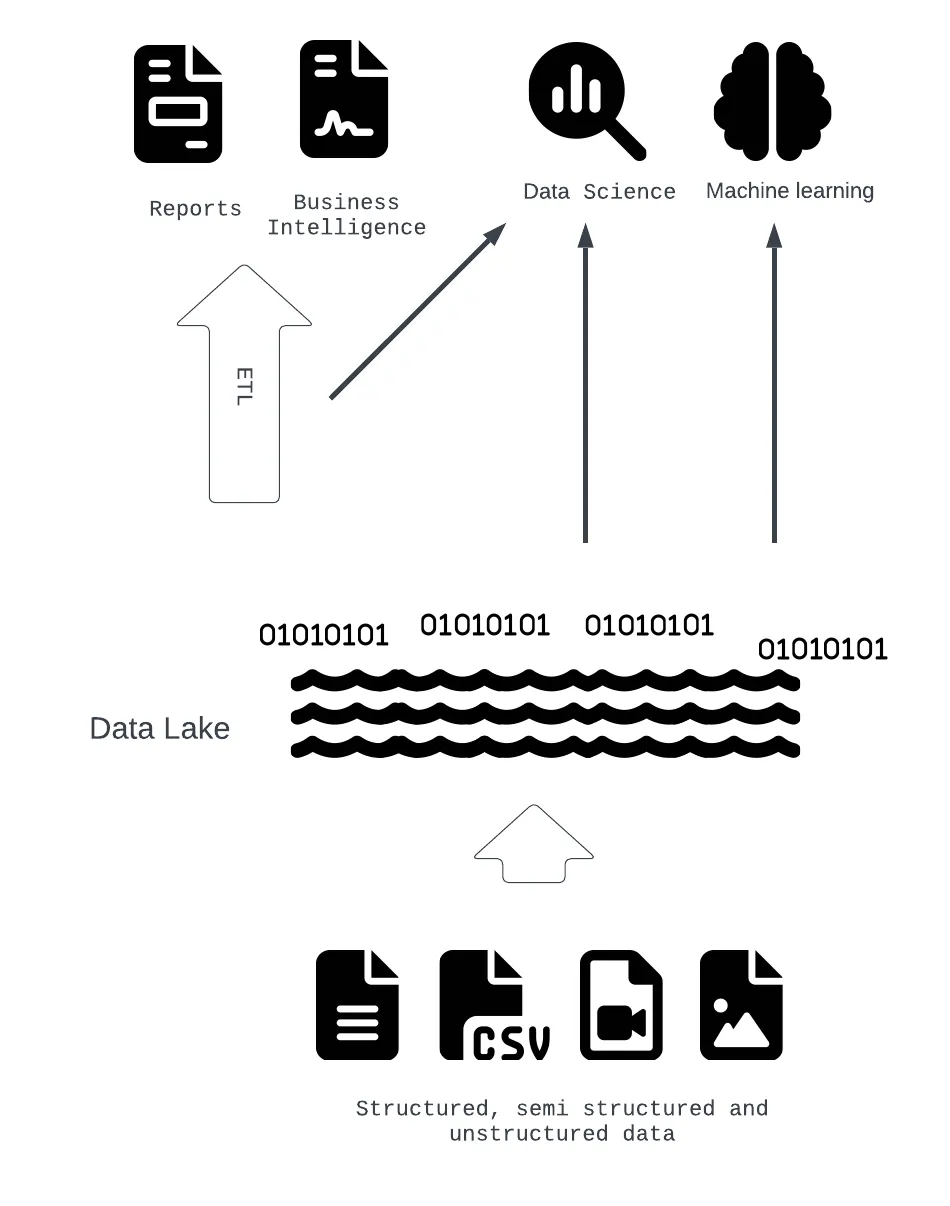
The Data lake pattern solves this problem. It is a central repository able to hold structured and unstructured data in its raw, native format. In a data lake, the schema isn’t imposed at ingestion; instead, it is inferred at read time. Thanks to this flexibility, diverse data types are easy to store and handle, which makes data lakes a good fit for data exploration and experimentation. They work well when the data structure is unclear or when you deal with raw, uncurated data that calls for exploration and ad-hoc analysis. The downside is that without a predefined schema, querying can be harder.
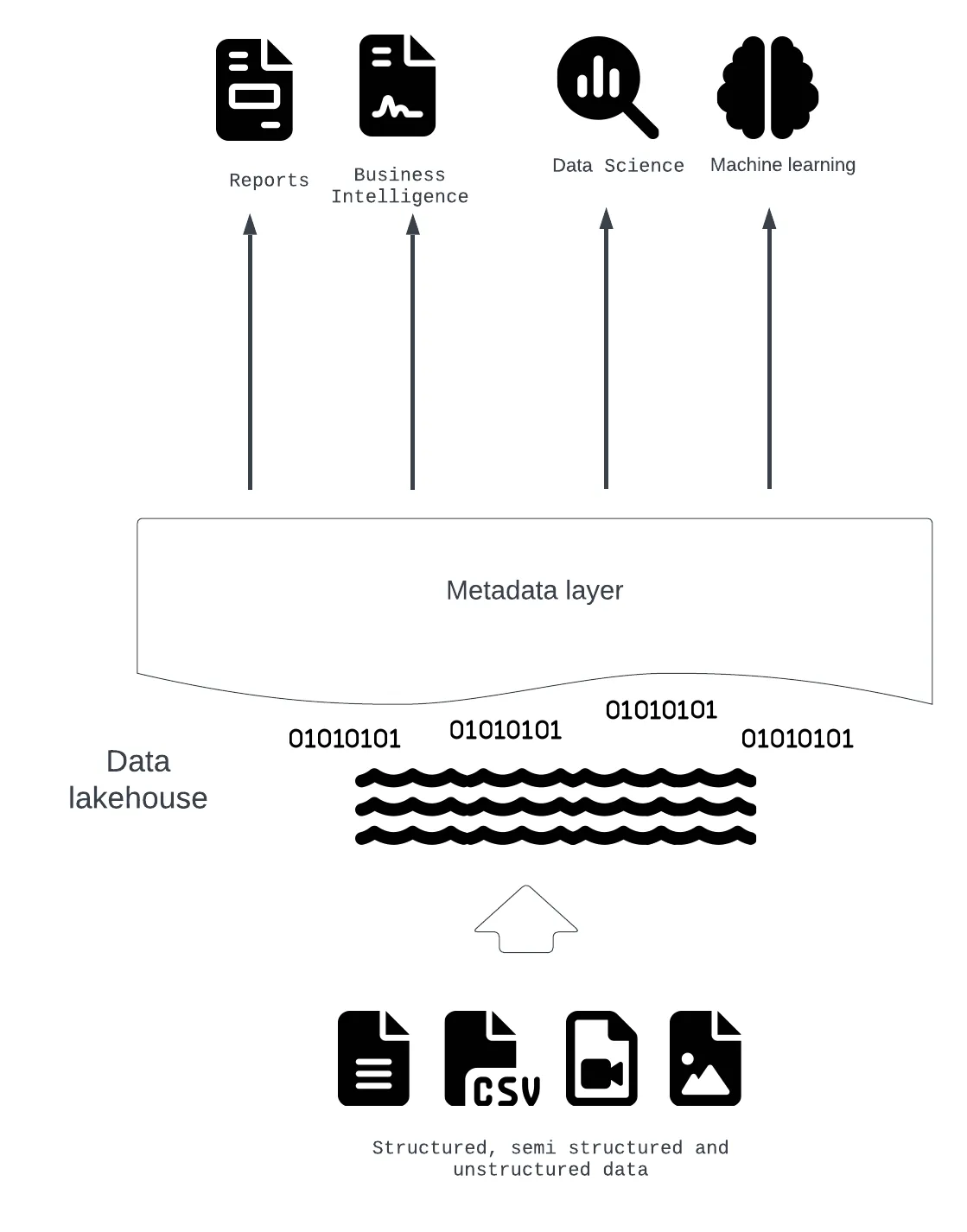
The data lakehouse pattern is a newer approach that merges the advantages of data warehouses and data lakes. It relies on a unified storage architecture holding both structured and unstructured data. Its ability to store varied information flexibly makes it resemble a data lake, while it also offers structured querying and data management features like a data warehouse. Data Lakehouse achieves this with technologies such as Delta Lake.
Each of the approaches described so far depends on centralized data storage, which can create bottlenecks and scaling problems as the volume and complexity of an organization’s data grow. It also puts a lot of pressure on a central data team. Data Mesh is a fairly new architectural paradigm for managing an organization’s data, suggesting a decentralized, domain-oriented way of handling it. Its central idea is to treat data as a product and spread ownership and responsibility for it across the various business domains. Every business unit becomes accountable for managing its own data, including quality, governance, and access. Data mesh gives domain experts more control over their data. The drawback is that dividing data into smaller pieces may make the data model more complex overall when viewed from the perspective of the whole organization.
Big Data storage is frequently implemented on on-premise servers using a variety of SQL or NoSQL databases – a common choice for institutions that would rather keep sensitive data in-house. In the cloud, there are many engines built for large-scale data warehousing and analytics workloads to pick from: Snowflake, AWS Redshift, Google BigQuery, and plenty more.
How do companies use Big Data?
As mentioned earlier, companies collect unimaginable amounts of data. The engine sensors of a single airplane alone generate 20 terabytes per hour. Without business context, however, that data is nothing more than a string of ones and zeros occupying disk space. It only becomes priceless when we can analyze it properly and extract practical insights.
Exploring Big Data underpins decision-making across many industries. It helps make therapies and patients’ lives better in healthcare, supports sound marketing decisions, and helps detect fraud. Finally, data powers today’s AI revolution. Machine Learning models are trained on huge amounts of information – and the quality and integrity of that data affect how efficient and correct the AI is.
In the paragraphs below, I describe classic use cases from four industry sectors that have gained from Big Data analytics.
Retail
Let’s begin with retail – an excellent example of data science applied in practice. The sector as a whole produces huge volumes of data from many sources: online and offline transactions, customer interactions, inventory levels, supply chain activities, and more. Its use of big data demonstrates the strength of data-driven decision-making, customer-centric strategies, and operational optimization, and shows how big data can reshape a traditional industry. Below are a few of the most common Big Data analytics use cases:
Behavior analysis
Retail companies apply data science and analytics to customer behavior in order to keep improving their offerings. They collect this information every time a user signs in and makes a purchase, or simply browses the store’s range of products. When customers return, they see products matched to their style and taste based on what they bought and browsed before. Even when they don’t intend to buy anything more, these personalized offers tempt them into additional purchases.
Target’s story is a well-known example of behavioral analytics done with Big Data. Target’s data engineers discovered that certain products, such as unscented lotion and vitamin supplements, suggested a customer might be pregnant when purchased together. Based on this, they created a pregnancy prediction score, which let them run targeted (no pun intended) ads for baby products aimed at women who scored high in the prediction function.
Inventory management
Retailers use Big Data analytics to optimize how they manage inventory. Accurate demand forecasts combined with analysis of historical and current sales data help them prevent both overstock and stockouts. For example, retailers may use Big Data analytics to predict seasonal demand for products.
Pricing adjustments
Another application of Big Data analytics in retail is setting prices based on an analysis of competitor pricing, historical sales data, customer demand, and market trends. Each of these factors is essential for building optimized, dynamic pricing plans.
Management of the supply chain
Retailers analyze logistics, transportation, and inventory level logs to optimize and simplify their supply chain operations. This leads to shorter wait times and fewer stockouts.
Market trend analysis
Big Data also supports retailers in analyzing market trends, customer preferences, and data about competitors. They study data from social media platforms, customer reviews, and online forums to understand how clients feel and what they prefer. This helps detect emerging trends and refine the product offering.
Healthcare
Big Data analytics has transformed the healthcare sector, fundamentally changing the way medical care is provided. Medical companies gather huge quantities of patient data, such as electronic health records (EHRs), genomic information, and real-time monitoring data, which can drive medical innovation and lead to better treatment outcomes.
A remarkable example of Big Data analytics is the real-time monitoring of COVID-19 case data, which let public health professionals pinpoint hotspots and follow how the disease spread.
Medical Data Analysis
Healthcare organizations rely on Big Data analytics to comb through enormous amounts of data and find patterns in population health, disease incidence, and treatment effectiveness. Healthcare facilities can use these findings to design new treatment protocols, distribute resources more sensibly, and back public health efforts such as disease surveillance and outbreak management.
Individualized Medical Care
Big Data enables personalized medicine, in which a patient’s care is adjusted to their genetic profile, lifestyle, and other traits. Medical professionals can thus design customized treatments for patients with difficult conditions, such as cancer, cardiovascular diseases, and rare genetic abnormalities. Medical facilities can, for example, use genomic data to identify alternative targeted cancer therapies based on a patient’s genetic abnormalities.
Pharmaceutical Development
Pharmaceutical companies collect biological, chemical, and clinical data to speed up the development of new drugs. The pharma industry applies machine learning algorithms to predict drug efficacy and toxicity, thereby reducing the cost of clinical trials.
Initial Predictive Analytics
Healthcare companies use the data they gather to predict disease outcomes and to find people at high risk of developing particular illnesses. Machine Learning models can, for instance, use data from wearable devices to anticipate health issues such as heart attacks.
Functional Effectiveness
Analyzing data on patient scheduling, resource allocation, and the supply chain can help healthcare organizations become more operationally efficient – by streamlining processes, reducing costs, improving patient flow, and reducing employee burnout.
Entertainment
Big Data analytics helps media companies understand their audiences better. The overriding aim is to raise user engagement and retention rates.
A suggestion for content
Media platforms use Big Data analytics to study user behavior and recommend content users are likely to enjoy. Every major music streaming platform creates playlist recommendations from users’ listening patterns, and video platforms rely on data analytics to suggest content based on what users watch.
Optimization of Advertising
Big Data lets businesses understand how consumers behave and what they prefer. This makes it possible to deliver more accurate and effective advertising, which leads to a better ROI.
Predictive Analytics
By analyzing data on user behavior and consumption habits, media firms can predict what kind of material will become popular. This reduces the risk of content flops and supports wiser investment decisions.
Monitoring of Performance
Media companies apply Big Data analytics to monitor how their content performs across many platforms, such as social media, streaming services, and websites. This can help them spot trends and refine their content strategy.
Finance
Big data analytics is indispensable for the financial services sector. FinTech companies rely on it to enhance customer experience and security, manage risk, and increase operational efficiency.
Consumer Research
Banking organizations use Big Data analytics technologies to find opportunities for cross-selling, upselling, and personalizing offers and promotions. While analyzing client feedback, they can also apply sentiment analysis to understand customers’ preferences and attitudes toward the institution.
- Risk Control
With the help of Big Data analytics, financial organizations can manage credit, market, and operational risks more effectively. By analyzing past market data, financial institutions can detect trends and patterns that guide decisions on how much risk to accept.
- Regulatory and compliance reporting
Analytics run on real-time transaction log data help banking organizations fulfill their regulatory obligations. Financial institutions can automate the collection and analysis of regulatory data to make sure they comply with rules such as Know Your Customer (KYC) and Anti-Money Laundering (AML)
- Analytics for trading and investment
FinTech applies Big Data analysis to study market patterns, financial information, and investment strategies, helping organizations make better trading and investment decisions. Financial institutions can analyze market data, such as stock prices or trade volumes, to find new investment opportunities and refine their trading strategies.
- Management of loans
Financial companies also use Big Data to predict loan default rates, assess borrower eligibility, and analyze credit risk. This results in leaner loan management procedures and a lower probability of default.
- Identifying fraud
Fraud comes in many forms, such as identity theft, unauthorized credit card transactions, or loyalty program scams. By studying transaction patterns, consumer behavior, and historical fraud data, FinTech companies can uncover potential issues. They analyze real-time data to catch suspicious patterns, such as transactions made from several locations within a short time or money transfers of an unusual size. Machine Learning models can detect unusual trends in customer behavior, like abrupt changes in purchasing habits.
Closing thought
Big Data has changed the way companies across many industries operate and make decisions. Data analytics is key to staying ahead in today’s competitive environment, and as AI grows in importance, it will matter even more.
Considering combining Big Data with Machine Learning to tap into the unused potential of your data? Through a data exploration process, we can validate your idea and build a PoC that shows you how to proceed.