ScyllaDB Is More Than Cassandra Written in C++ – Take a Second Look
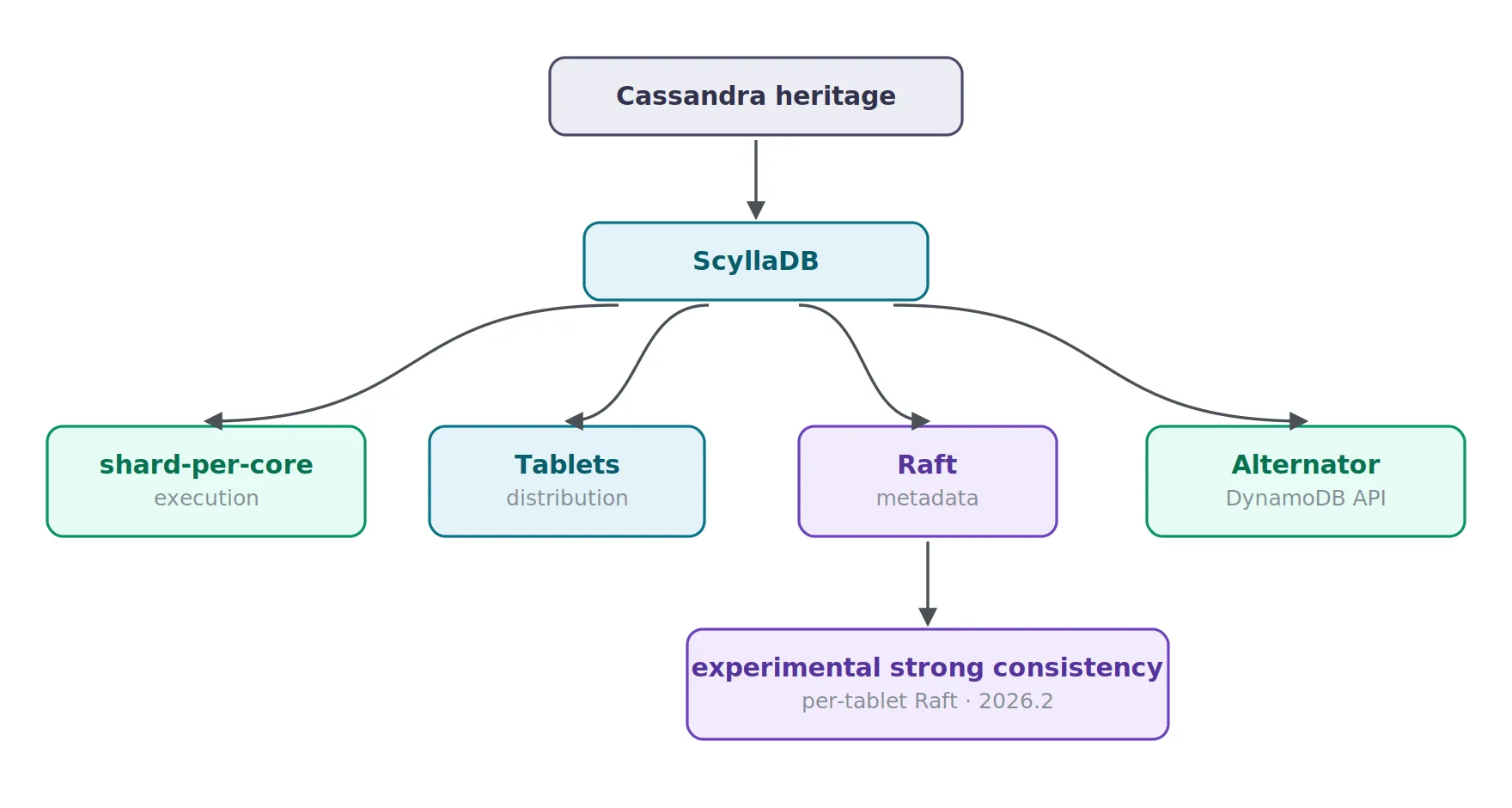
ScyllaDB began life as a faster reimplementation of Cassandra. Tablets, Raft, strong consistency and DynamoDB compatibility reveal how far it has grown past that model.
People often sum up ScyllaDB as Cassandra reimplemented in C++. The initial idea was simple: retain the data model and the CQL ecosystem, but swap the JVM for Seastar, asynchronous I/O and a shard-per-core architecture. Make efficient use of multicore hardware, steer clear of garbage-collection pauses and keep latency predictable.
In consulting engagements, teams still tend to frame a ScyllaDB migration as moving to a “faster Cassandra”. Yet data placement, cluster management and even the storage engine are all evolving:
| How ScyllaDB used to be seen | ScyllaDB now |
|---|---|
| A Cassandra-compatible database with a different implementation | More and more a database architecture of its own |
| Data is spread by vNodes and the token ring | Tablets spread individual tables dynamically |
| Schema and topology are coordinated through Gossip | Raft puts schema and topology changes in order |
| Tunable eventual consistency together with LWT | Experimental per-tablet Raft adds strong consistency for user data |
| Mainly the CQL/Cassandra ecosystem | CQL plus an extensive DynamoDB-compatible API |
| ScyllaDB Open Source licensed under AGPL | Core database releases are now source-available |
The release overview that follows goes up to ScyllaDB 2026.2, in which Strongly Consistent Tables and online vNode-to-Tablet migration are experimental. Logstor is treated separately, as work still in development.
The first difference lay within a single node
Cassandra and early ScyllaDB alike spread data across nodes with a token ring. ScyllaDB additionally introduced sharding within every node, relying on Seastar’s shard-per-core architecture.
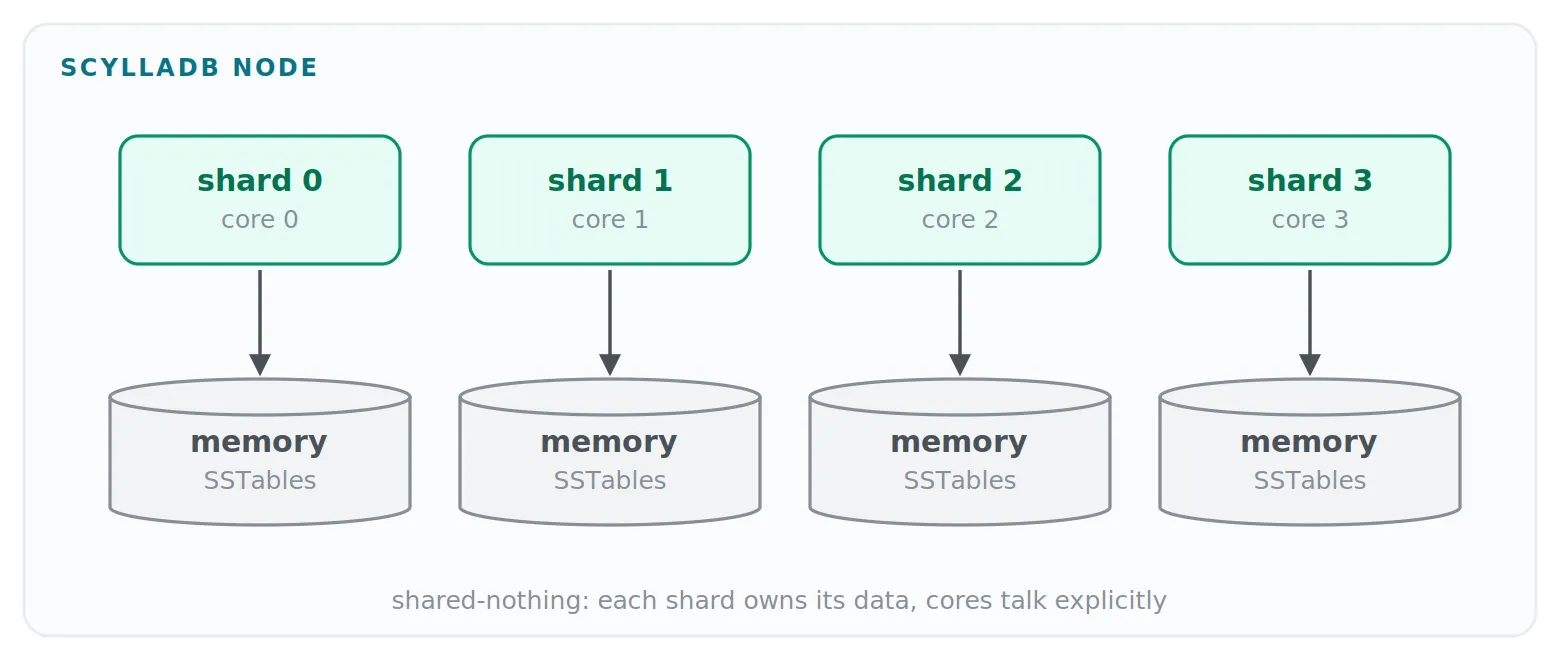
A shard is the portion of ScyllaDB that runs on a single CPU core and has its own data and resources. It handles many CQL partitions, each of which groups rows sharing a partition key. Shards talk to each other explicitly, so most of the work stays on the local core. More details are in ScyllaDB’s shard-per-core overview.
Shard-aware drivers send requests straight to the core that owns the data, saving an additional hop between cores. Tablet-aware drivers additionally discover where tablets live from the routing information the server sends back, and refresh their caches when placement changes. Older shard-aware drivers keep working, though their routing is less efficient.
With tablets, data placement is defined per table
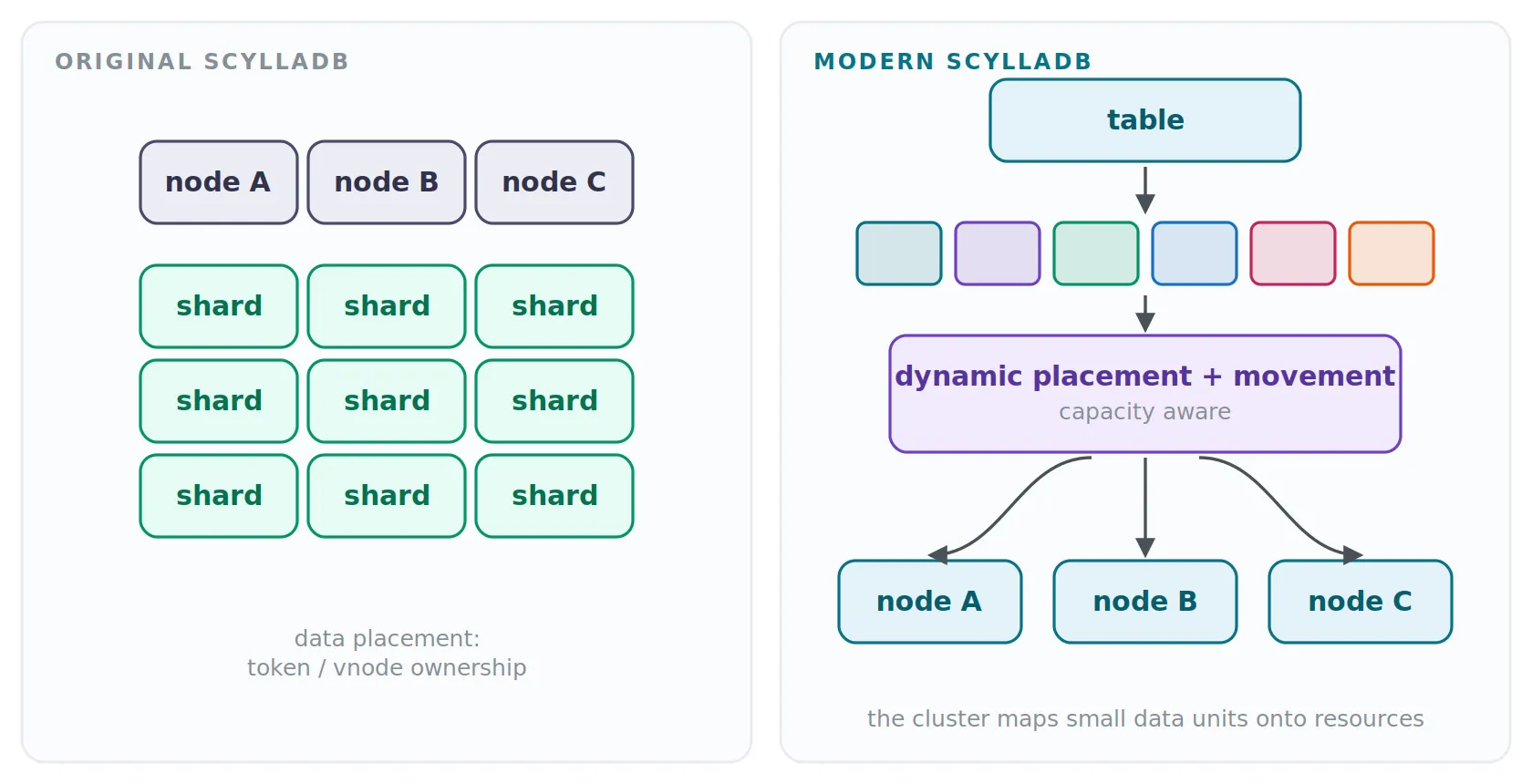
Under vNodes, a partition key is hashed into a token, and placement follows from which node owns that token in the cluster. Every physical node owns several ranges. All tables share this ownership map, and replication settings decide where the replicas go.
A tablet stands for a token range of a single table. Its replicas sit on specific nodes and shards. Every table can split the token space in its own way, and a single shard can host numerous tablet replicas.
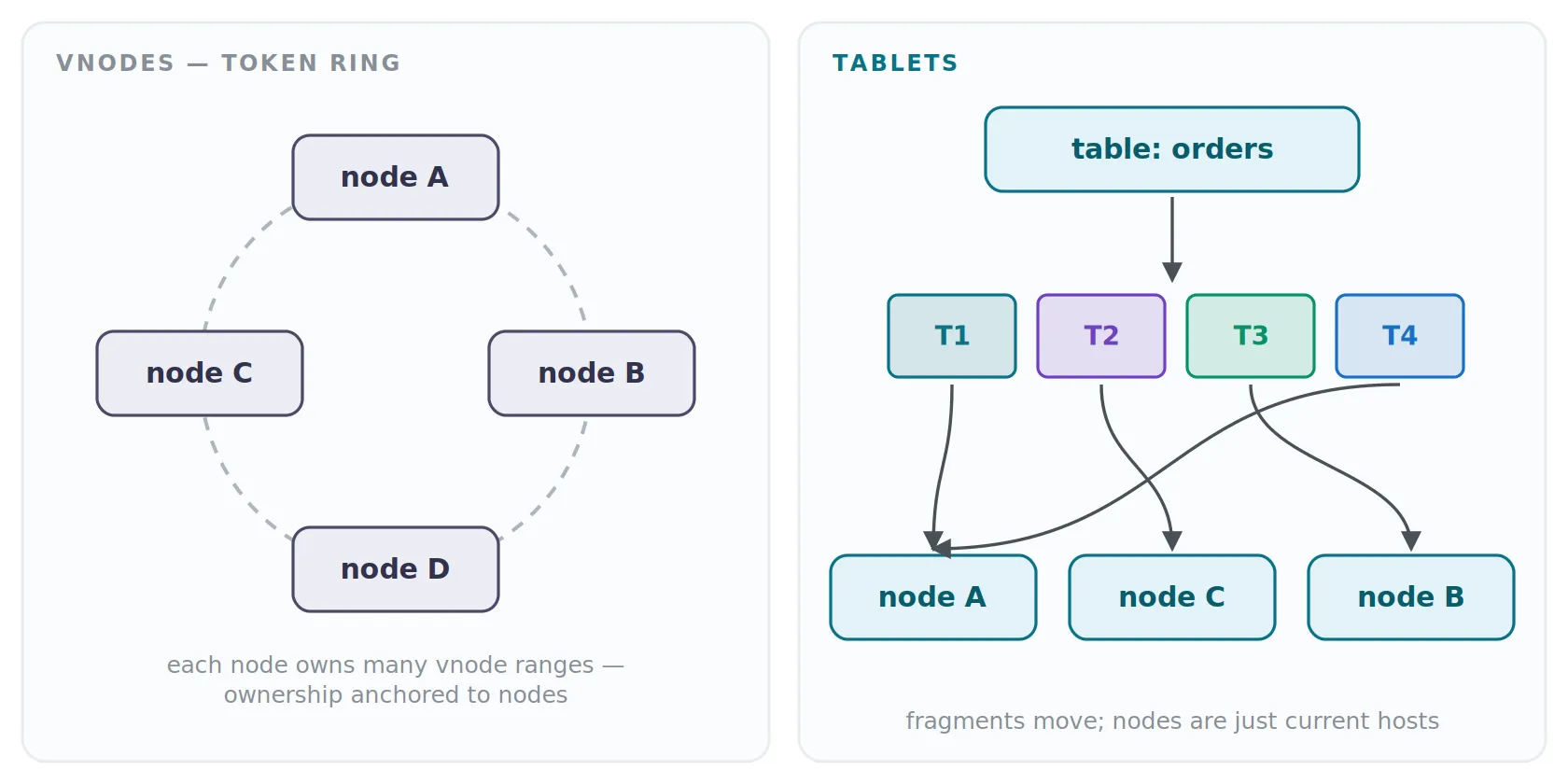
Say an events table holds several terabytes, while a customers table holds just a few gigabytes. There’s no reason for both to be distributed at the same granularity. When events grows, its tablets can split and the new tablets can be moved independently, while the smaller table can stay with fewer tablets.
The balancer is able to relocate a tablet replica to a different node or to a different shard on the same node. Thanks to splitting and merging, the database can tune the size of the units it manages. Token ranges are still there; it’s just that ownership is now handled per table.
One significant limitation remains: each CQL partition lives in exactly one tablet. Splitting a tablet partitions a range of partitions, not what’s inside a single partition. So a badly chosen partition key can still lead to a hot or oversized partition. Tablets give the database more freedom in placing data, but they won’t spread that single partition over separate tablets for you.
What happens when you add capacity?
Imagine you bring in a bigger machine as part of a hardware refresh. With vnode placement, the token allocation has to hand it a fitting share of the data. With tablets, the balancer can shift individual tablet replicas onto it and keep fine-tuning placement as the cluster evolves.
The capacity-aware balancing introduced in 2026.1 takes tablet sizes and node capacity into account to tackle uneven disk usage, where one node runs out of space while others still have room.
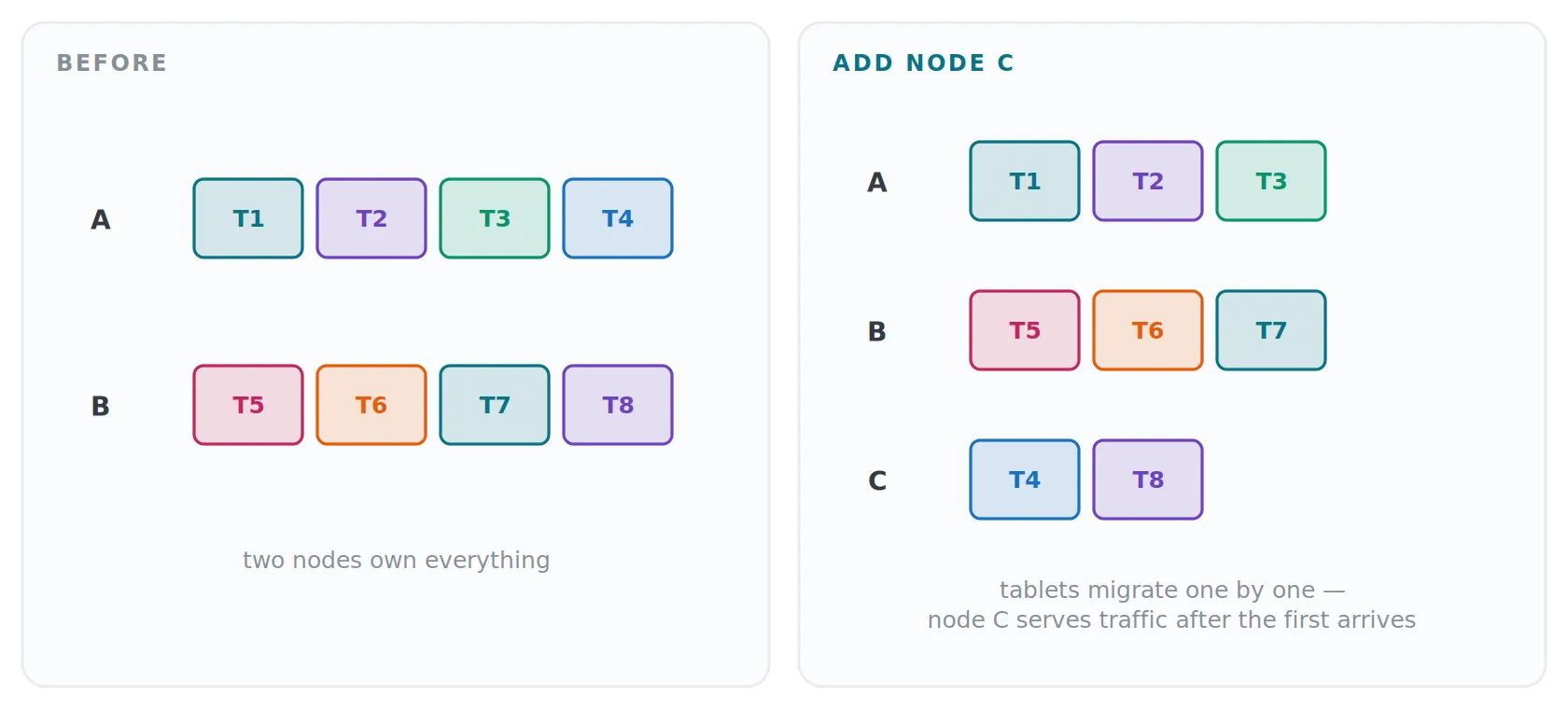
Running mixed hardware becomes more realistic, but “capacity-aware” doesn’t mean that every resource ends up evenly used. Disk space, CPU capacity and request traffic are separate constraints. A node with lots of free disk might already be busy handling a popular partition. I’d still measure the real workload before assuming that a hardware refresh will bring proportional gains.
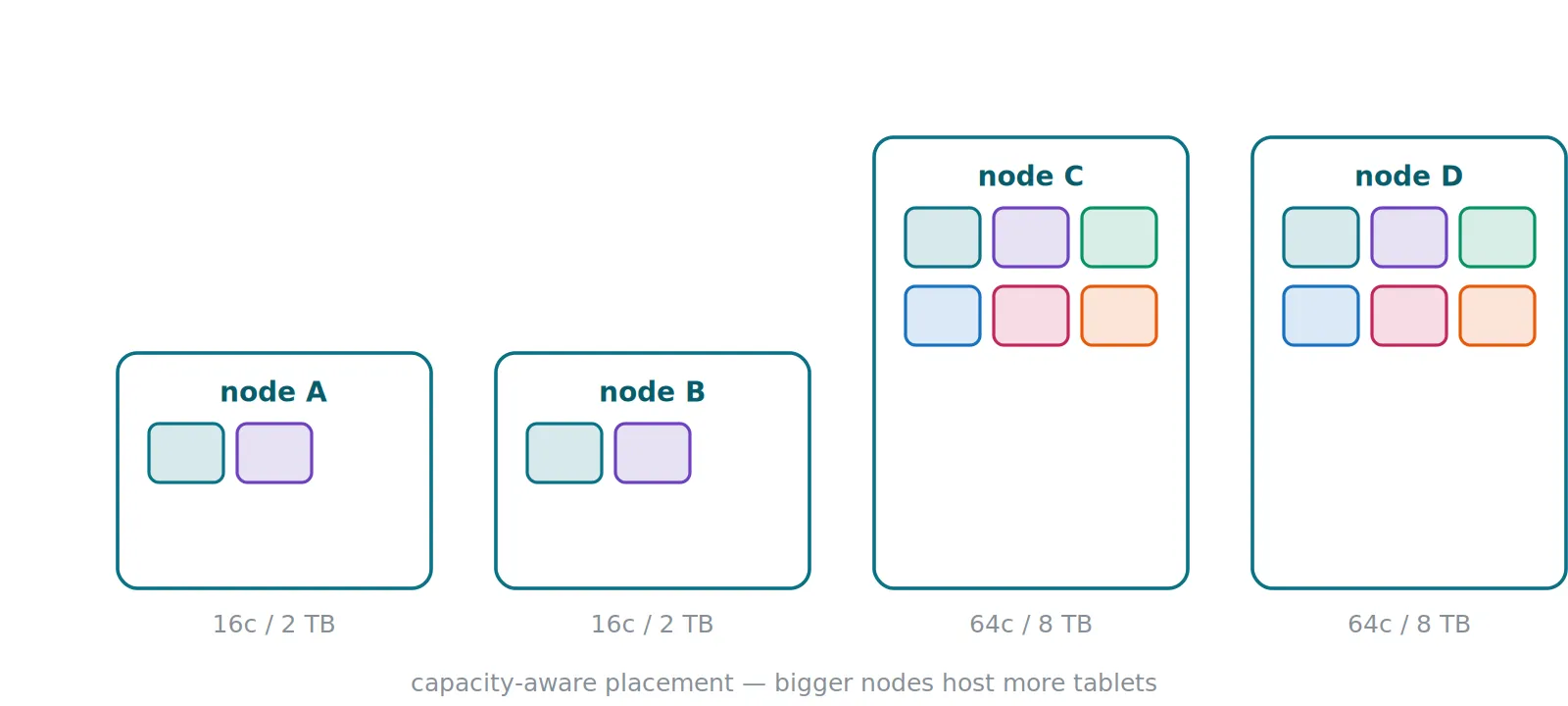
Tablet migration relies on file-based streaming as well. Moving SSTables as files spares part of the effort of decoding and re-encoding their contents during rebalancing.
Tablets are mature; migration still deserves care
They were rolled out across several releases:
| Release | What changed |
|---|---|
| 6.0, June 2024 | Tablets on by default for new clusters, together with strongly consistent topology updates; support for differing core counts. |
| 2024.2 | Tablets arrived in the Enterprise line. A number of features still needed vNodes. |
| 2025.1 | Tablet merge and file-based streaming, in the first unified product release. |
| 2026.1 | Support for counters and capacity-aware balancing. According to the release notes, tablets no longer lag behind vNodes in features. |
| 2026.2 | Online migration from vNodes to tablets, as an experimental feature. |
This final point is important for existing deployments. The fact that new clusters get tablets by default doesn’t mean an upgrade turns every existing vnode-based table into a tablet-based one. It’s worth checking separately how your current tables are placed and which migration procedure is supported.
Raft brings order to schema and topology changes
Gossip works well for spreading what nodes observe about one another. Concurrent schema changes, however, need something stricter: consensus on which change goes first.
ScyllaDB’s Raft documentation explains how the older schema mechanism could drop changes when nodes resolved conflicting updates by timestamp. Raft-based schema management, turned on by default for new clusters in 5.2, routes these operations through a consensus log.
Topology management came next. Bootstrap, decommission, node removal and replacement now operate on an agreed view of who belongs to the cluster. The database coordinates their order and progress, which makes operations such as adding several nodes at once possible. Consistent topology changes became mandatory in 2025.2.
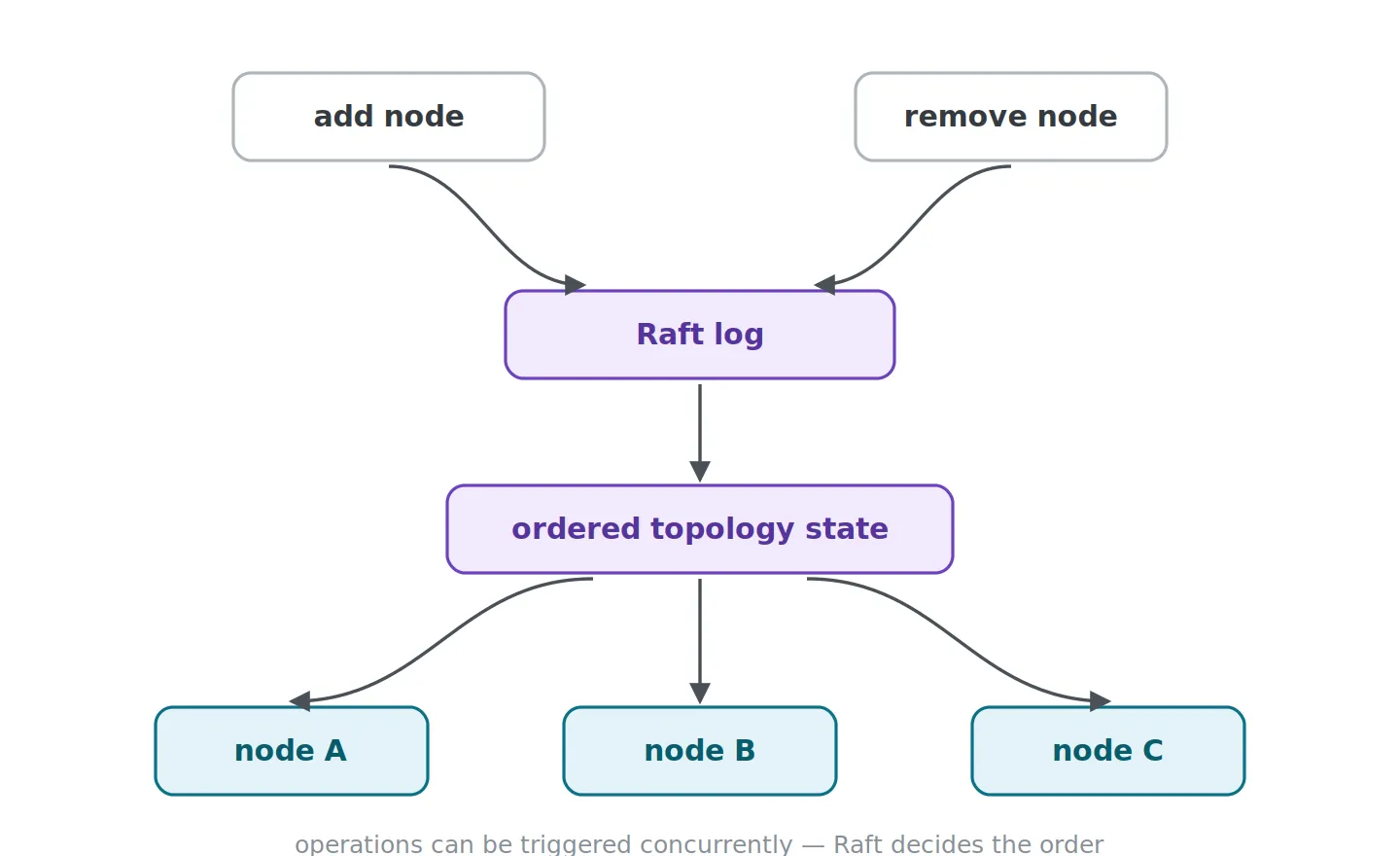
This affects how failures play out. If the metadata Raft quorum is lost, schema and topology changes can be blocked. Regular reads and writes may carry on as long as the required data replicas can be reached and the requested consistency level can be satisfied. That doesn’t guarantee application traffic is untouched by a metadata-quorum failure, though: the very same failed nodes or network partition may also make data unavailable.
Gossip is still used to spread node state. Raft is in charge of metadata that requires an agreed order. Cassandra’s Transactional Cluster Metadata proposal tackles a related issue, so this is another area where comparing against an old Cassandra release can lead you astray. Both projects have been reworking cluster management.
Raft for user data is a step of its own
Running schema through Raft doesn’t make regular table operations strongly consistent. They still rely on the well-known consistency levels, such as ONE, QUORUM and LOCAL_QUORUM. Conditional writes go through Lightweight Transactions, which are built on Paxos.
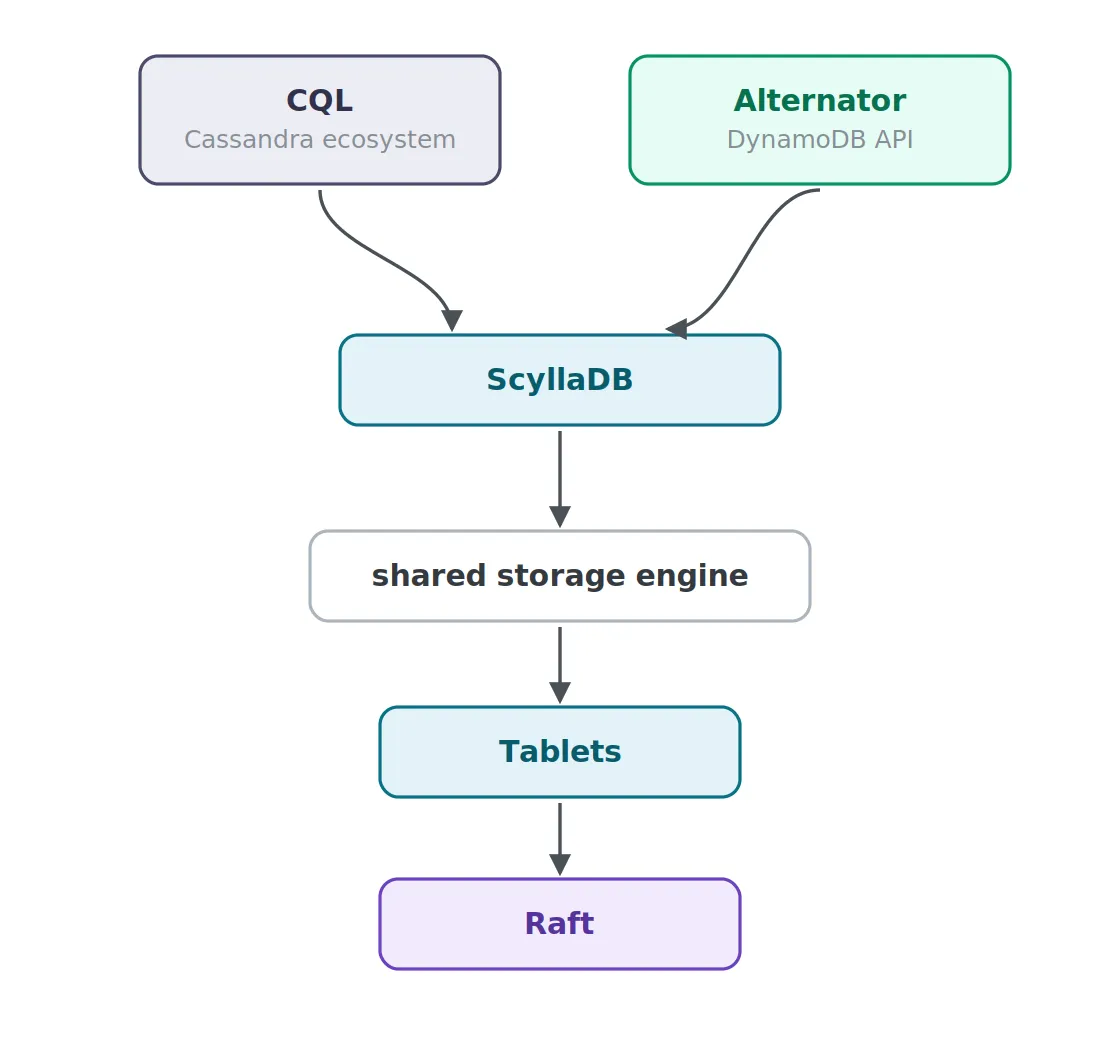
The experimental Strongly Consistent Tables feature in 2026.2 brings Raft into the user-data path, with one Raft group for each tablet. Tablets form a natural boundary here: the database already knows which replicas store each unit of data, and separate groups can coordinate on their own.
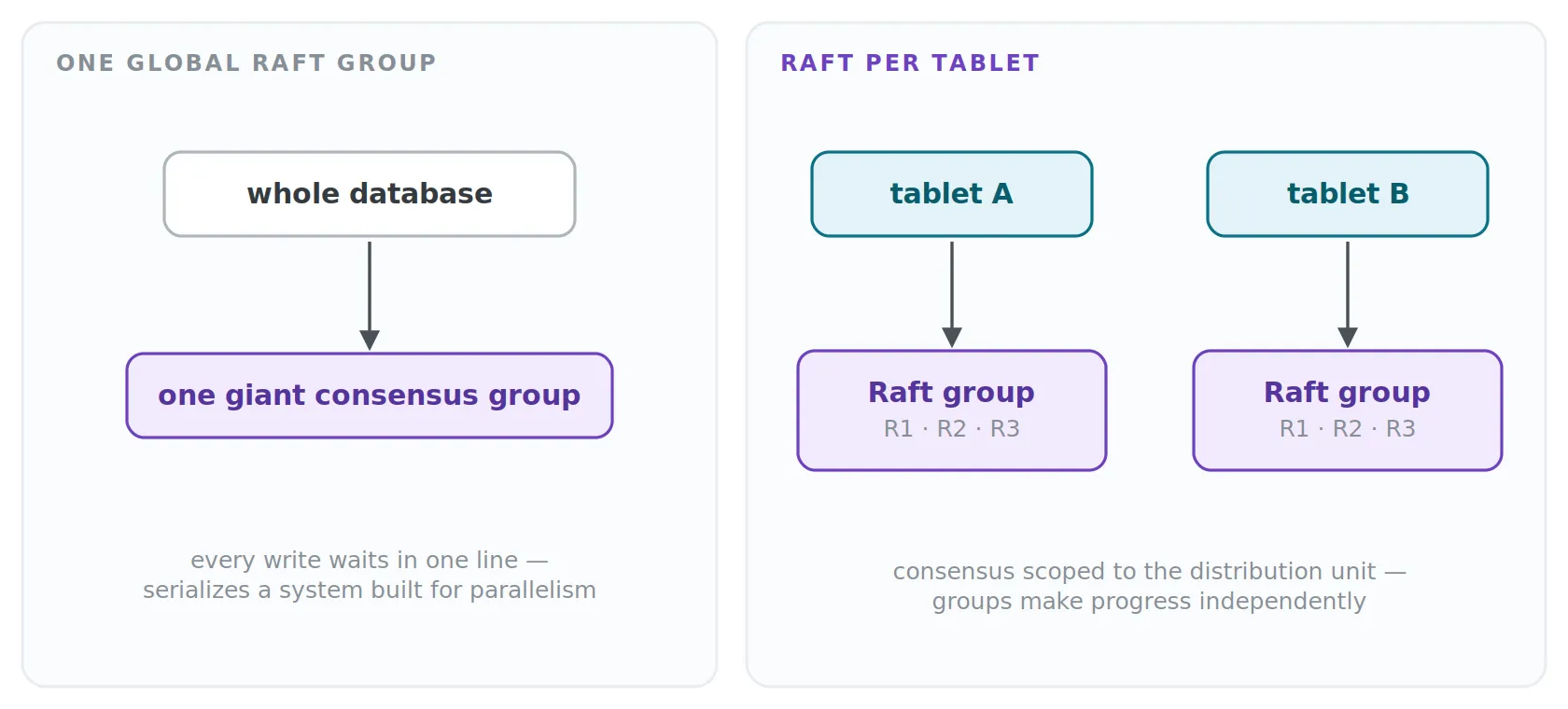
The experimental guarantee applies to requests targeting the same partition. Multi-key transactions are still a longer-term goal.
Writes backed by Raft need agreement within their replication group, so they are directly affected by replica placement, network latency and quorum availability. Metadata Raft and per-tablet Raft serve different purposes and have different quorum requirements.
Alternator adds a second API to ScyllaDB
Cassandra compatibility is no longer the only interface ScyllaDB offers to applications. Alternator provides a DynamoDB-compatible API implemented directly on top of ScyllaDB storage. A DynamoDB hash key corresponds to a partition key, and an optional sort key corresponds to a clustering key.
This brings ScyllaDB into a different kind of migration conversation. A team on DynamoDB might want to keep its application API intact while changing where the database runs and how it’s operated.
Compatibility has to be verified beyond PutItem and GetItem. Applications also rely on indexes, conditional operations, streams and the behaviour of their SDKs. Getting the basic request format right is just one piece of a migration.
In 2026.2, Alternator Streams reached general availability. They expose item-level changes in order, which supports applications that respond to updates. This shouldn’t be taken as a table-wide global ordering guarantee or as an end-to-end exactly-once guarantee for consumers. The same release also extended the DynamoDB-compatible API with vector search, which is available via ScyllaDB Cloud.
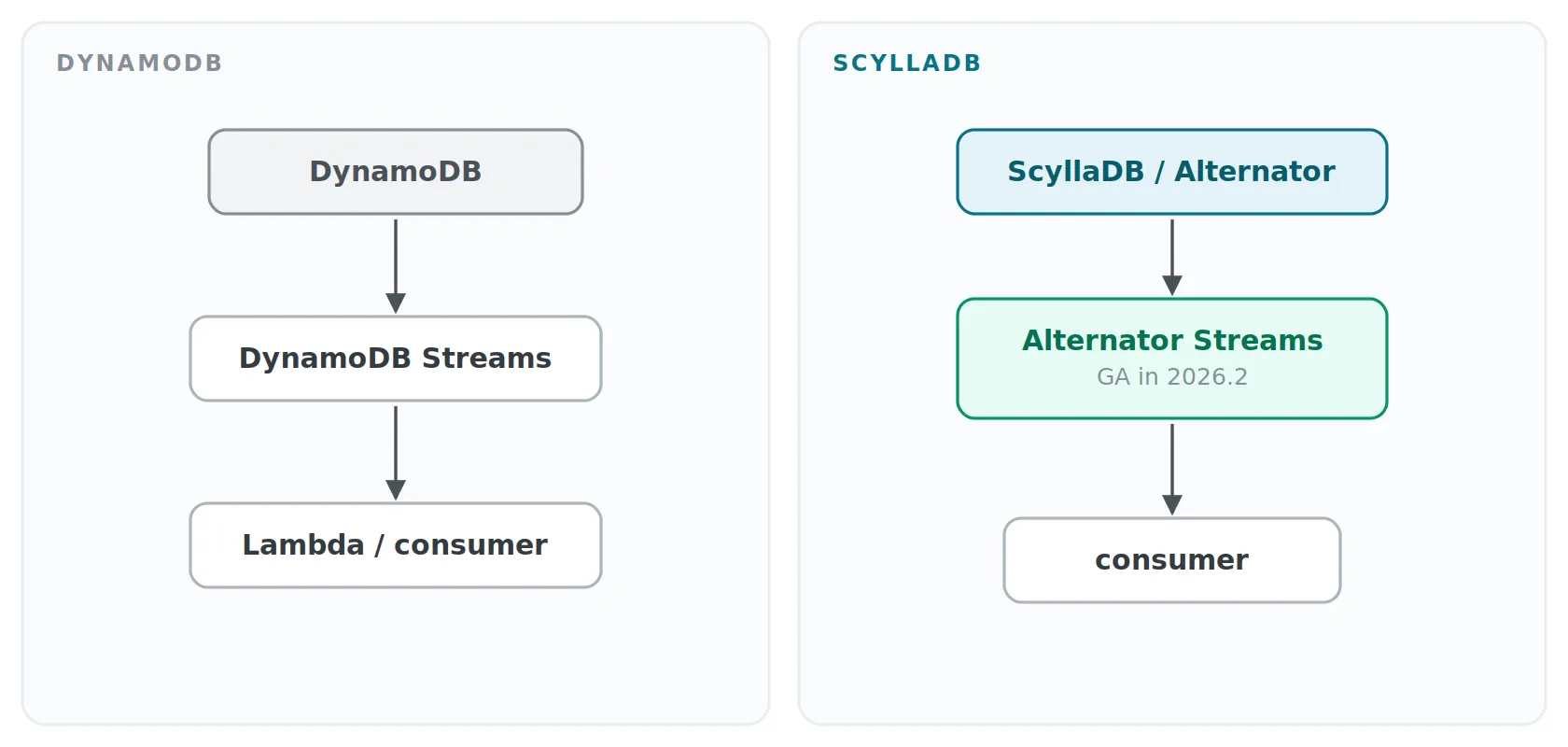
Alternator tables can also use tablets, relying on the same placement and migration machinery as CQL tables.
Repair is becoming part of the database
Replicas still have to be repaired. Tablets and Raft-managed topology don’t eliminate this need for regular replicated tables.
In addition to repair driven by ScyllaDB Manager, ScyllaDB offers built-in automatic repair for tablet tables. Incremental repair is likewise linked to the tablet architecture.
The database can plan repair around the units it already keeps track of for placement. Find out which tables use tablets, what their repair settings are, and how you’ll monitor completion and failures.
Logstor tries out a different storage engine
Logstor is an experimental key-value backend that appends records to log segments and maintains an in-memory index of where they are. Compaction moves live records elsewhere so that space in old segments can be reclaimed. It’s a storage path distinct from memtables and SSTables, and the memory used by the index is part of its cost.
The development snapshot looked at here, which is also described on DeepWiki, needs an experimental feature flag; this is not a statement that it’s available in 2026.2. I’d keep an eye on it for workloads that mostly replace values and look them up by key. Whether it turns out to be a worthwhile alternative depends on which operations it supports and how it behaves when measured.
The data-model limitations are the familiar ones
CQL, partition keys, clustering keys, replication factors, memtables and SSTables are still at the core of ScyllaDB. A lot of the hands-on knowledge gained from running Cassandra remains relevant.
You still have to design partition keys around access patterns, keep partition size under control, understand tombstones and compaction, and pick consistency levels on purpose. A busy partition can still overwhelm a shard. A heavy deletion workload can still cause read amplification. Adding nodes won’t solve either issue on its own.
That’s why, during a migration, I’d keep Cassandra data-model expertise at hand while questioning operational assumptions about placement, drivers, topology changes and repair. Familiar CQL can make a system seem more familiar than it really is.
The licence is part of the evaluation
Today’s ScyllaDB database releases are source-available rather than AGPL open source. ScyllaDB OSS 6.2.x was the last database release under AGPL. With 2025.1, the company merged its Open Source and Enterprise streams into a single product line.
According to the source-available FAQ, free use is capped at 10 TB of total provisioned disk capacity and 50 vCPUs per organisation, counted across clusters. The disk cap applies to capacity, not only to how much application data is stored. These limits aren’t the only eligibility criterion: the current licence agreement also lays down conditions for eligibility and use.
Older AGPL releases keep their licences. Seastar, the drivers and the Kubernetes operator are licensed separately. For a new deployment that uses current database features, though, the source-available terms have to be factored into the decision from day one.
What I would compare now
If I had to name the change that most shapes how I think about ScyllaDB, I’d pick tablets. Shard-per-core decides how work is split within a server. Tablets give ScyllaDB more fine-grained control over placement across the cluster, as well as a unit on which migration, balancing, repair and now experimental data consensus can be built.
An evaluation of Cassandra versus ScyllaDB should therefore look further than steady-state throughput. I’d test adding and replacing nodes under load, watch latency while tablets are moving, confirm client routing and review the repair procedure. I’d also separate mature functionality from experimental features before comparing feature lists.
The execution engine is still important. But a cluster that answers queries quickly and a cluster that can redistribute data predictably address different aspects of the operational challenge. Tablets and Raft turn the second aspect into a much bigger part of the ScyllaDB conversation.
Here are the differences I’d put into a Cassandra – ScyllaDB comparison today: