ASVS 5.0: What Has Changed
A look at the most important changes in OWASP ASVS 5.0: reworked levels, leaner controls, and clearer guidance for building secure web applications.
The Application Security Verification Standard (ASVS), one of OWASP’s flagship projects, has just received its first major release in six years. Compared with the previous version, it’s been called a full overhaul. Let’s see which changes and improvements it introduces.
source: https://asvs.dev/
1. Introduction
ASVS is a collection of security guidelines for web applications and services. Application security matters more today than ever, so a dependable, structured approach to secure development is a must. Put differently, ASVS provides a comprehensive framework for checking how secure web applications and services are. While the OWASP Top 10 concentrates on the most widespread risks, ASVS delivers a complete, actionable standard covering every phase of your application. In its updated form, it is a stronger basis than ever for teams that want their software to be secure by design.
The previous ASVS release – v4.0.3 – came out in 2021. The gaps between major versions of the project differ, but in total the project has existed for over 15 years. And now v5.0 has just arrived.
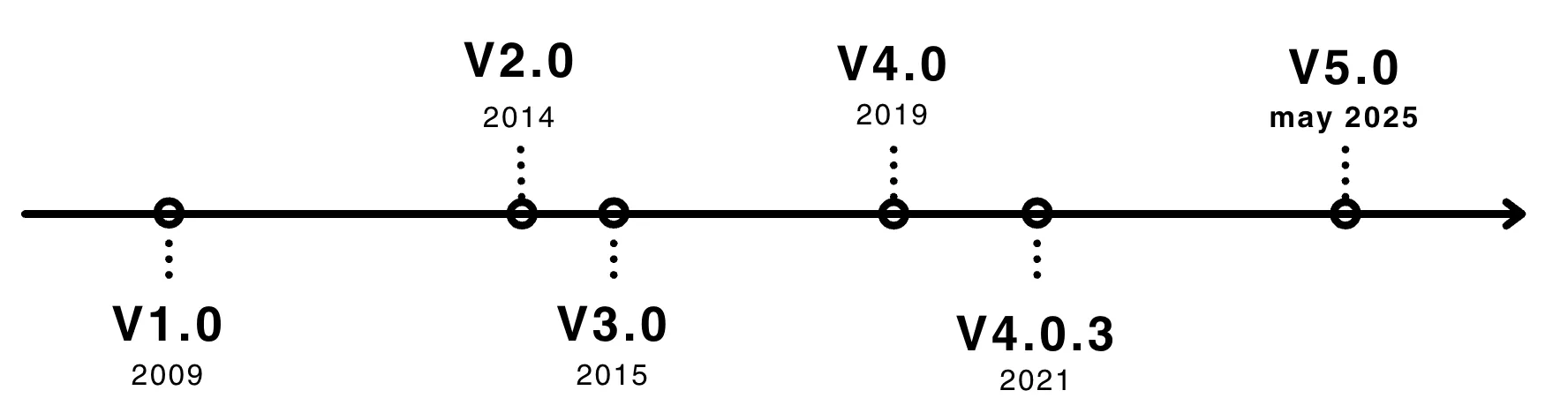
Timeline of ASVS releases
2. What’s new?
To start with, ASVS used to be distributed mostly as a PDF, but now it has its own website – asvs.dev – where both the current and older editions can be browsed easily.
The ASVS document itself lists the biggest changes for people who used v4 – Guidance for users of version 4.0. I’ll also go over them here in a consolidated, comprehensive way:
Change in levels approach
In my view, the most striking change in ASVS 5.0 is the revised approach to verification levels. In ASVS v4, L1, described as the “bare minimum”, required exactly 131 controls – a high hurdle for anyone starting out. Meanwhile, L3 (which includes L1 & L2) had only 20 more controls than L2.
L1 had so many controls because all of them could be covered by black-box security testing. Although the intention was good, some saw this as an unrealistic starting point, and as a result many teams either didn’t adopt ASVS at all or implemented it only partially, never reaching full Level 1.
In v5.0, the goal was to make getting started easier without weakening security objectives. ASVS v5 achieves this by rebalancing the levels so that level 1 is more attainable. The aim is to help organizations adopt the standard and then progress step by step to level 2 and higher.
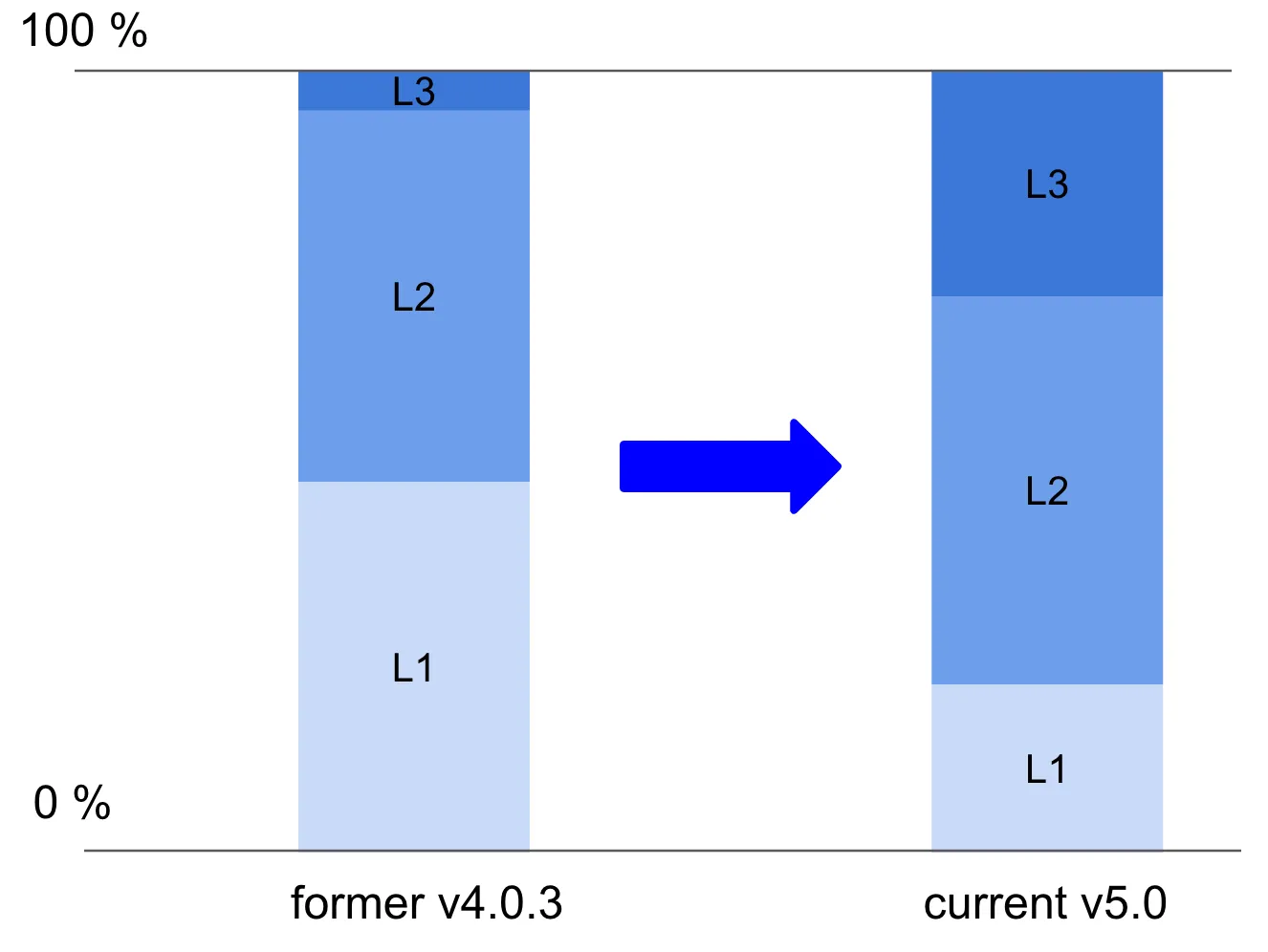
Rough comparison of how big each level is
Complete renumbering and reordering
ASVS v5.0 fully restructures its requirements: the numbering has changed, duplicates have been removed, and nearly every requirement has been rephrased. A mapping document from v4.0.3 to v.5.0 helps make sense of these changes – it shows what happened to each requirement (whether it was moved, modified, merged, and so on).
To illustrate the difference, let’s examine two sample requirements from ASVS v.4.0.3. Their requirements and security levels were modified, they were moved to other sections, and they were combined into one:
How the versions differ, source: ASVS v4.0.3 & v5.0
Less coupling with CWE & NIST
ASVS v5.0 drops the direct mappings to MITRE’s Common Weakness Enumeration (CWE). CWE is still a useful classification of software weaknesses, but some links between ASVS and CWE were unclear or inexact, and some requirements didn’t correspond neatly to a single CWE. From now on, mappings will be maintained via the OWASP’s Common Requirement Enumeration (CRE) project, which provides more flexible cross-references to other OWASP resources.
ASVS v5 also relies less on external mappings such as NIST’s Digital Identity Guidelines. These are still respected and officially maintained, but the mappings now sit in a separate section, outside the main list of requirements.
3. Personal picks from the new version
Everything described so far comes from the official documentation. What follows are my own observations and thoughts on the new version.
No controls related to “AI”
You might expect any new application security standard published in 2025 to contain at least a few requirements concerning AI in the broad sense. This one doesn’t, and that’s intentional – according to the ASVS authors, “It deserves a standard of its own”.
That separate effort has already started – AISVS (Artificial Intelligence Security Verification Standard) is an OWASP project dedicated to security requirements for AI systems. It intends to cover both traditional machine learning pipelines and modern LLM-based architectures, providing structured guidance in the area ASVS deliberately leaves out. AISVS is at an early stage for now, and there is no official release date or timeline yet.
If OWASP and AI topics interest you, take a look at OWASP AI Exchange for a wider view of OWASP’s AI-related projects, or at OWASP Top 10 for Large Language Model Applications for high-level risks and mitigations concerning LLMs and generative AI applications.
Transparency with level 1 penetration testing
In the earlier ASVS v4.0.3, level 1 was presented as the “bare minimum”, said to be optimized for thorough verification through penetration testing. At the same time, the standard promoted hybrid assessments and stated outright that black-box testing, though technically feasible at Level 1, was “not an effective assurance activity”. v5.0 removes this ambiguity: it now says plainly that meaningful verification needs access to internal artifacts and that black-box testing on its own is not enough.
Level 3 requirements
ASVS v5.0 significantly broadens level 3. Version 4.0.3 had only around 20 level 3 requirements on top of level 2; now there are about 90. Notably (based on the mapping from v5.0 to v4.0.3), over half of them are brand new rather than simply moved up from level 2.
One example of this growth is an entirely new chapter, V10.4 OAuth Authorization Server, which adds 16 new requirements across all levels, 5 of them at level 3. These controls deal with advanced OAuth topics, such as enforcing a fixed, client-specific response_mode or issuing sender-constrained access tokens via mutual TLS (mTLS) or Demonstration of Proof of Possession (DPoP).
In rare cases, a requirement’s level has actually gone down, e.g.:
- v4.0.3-9.2.5 L3: Verify that backend TLS connection failures are logged has been moved down to level 2 and generalized into:
- v5.0-16.3.4 L2: Verify that the application logs unexpected errors and security control failures such as backend TLS failures.
Post-Quantum Cryptography
An important new item is requirement 11.1.4 (level 3), which reflects the increasing pressure to future-proof cryptographic systems against quantum computing. It stresses the need for a plan for future migration – a clear message that quantum threats may not be imminent, but proactive planning should begin now.
AWS’s post-quantum cryptography migration plan is a good example of this kind of foresight: it describes how they identify vulnerable assets, test quantum-safe algorithms, and prepare for wider adoption down the line.
Reduced password length
The earlier requirement v4.0.3-2.1.1 called for passwords of at least 12 characters. In the new version, control v5-6.2.1 (level 1) lowers the minimum password length to 8 characters, while strongly recommending at least 15 characters. The change aims to bring ASVS in line with the NIST SP 800-63B v4 authentication standard. From what I’ve seen, it sparked more discussion (GitHub issues, OWASP slack) than any other change.
Deleted requirements
Something I like is that the new version removes certain requirements and explicitly explains why – you can check this in the mapping from v4.0.3 to v.5.0 mentioned earlier. Many were dropped because they were merged or covered elsewhere, but others received more explicit labels, such as DELETED, INCORRECT, NOT PRACTICAL, or INSUFFICIENT IMPACT. Here are a few requirements removed from the previous version, with context drawn from discussions in ASVS GitHub issues:
- v4.0.3-2.4.2 (incorrect): Demanded salts of at least 32 bits – Modern hashing algorithms such as Argon2, bcrypt, and PBKDF2 already take care of salting securely, so the requirement became obsolete (issue #994).
- v4.0.3-14.5.4 (incorrect): Demanded that apps authenticate HTTP headers coming from proxies or SSO devices – it added nothing beyond the existing requirements (issue #1529).
- v4.0.3-8.3.6 (not practical): Demanded that sensitive data in memory be zeroed after use – the discussion concluded it should be dropped, since in most cases it can’t be done in practice (issue #1225).
- v4.0.3-2.1.4 (insufficient impact): Promoted allowing every printable Unicode character in passwords – dropped because its impact was minimal, and with MFA everywhere it hardly matters (issue #2239).
Summary
I consider the lower entry barrier at Level 1 to be the most important change in ASVS v5.0 – the level now concentrates on fewer controls that are more impactful, attainable, and meaningful. This may encourage more teams to aim for Level 1 with confidence instead of feeling overwhelmed, and to treat Level 2 as the natural next step. The new version also has a more consistent structure and more precise terminology. Thanks to its renewed emphasis on usability and realistic adoption, ASVS 5.0 is a strong update that makes secure development easier to approach without lowering quality.
At our company, ASVS is one of the core standards we rely on when building secure software for our clients.